I was introduced to Pedro through the usual social channels – I think it was probably Facebook. After reading about his travels I felt a sense of déjà vu. His story of overlanding from Europe to Asia bore a close resemblance to that of Greg and Emma (who we have previously interviewed). Things got even more bizarre when I discovered his next journey was from Europe to South Africa (their next trip was from South Africa to Asia). I knew I had to interview him!

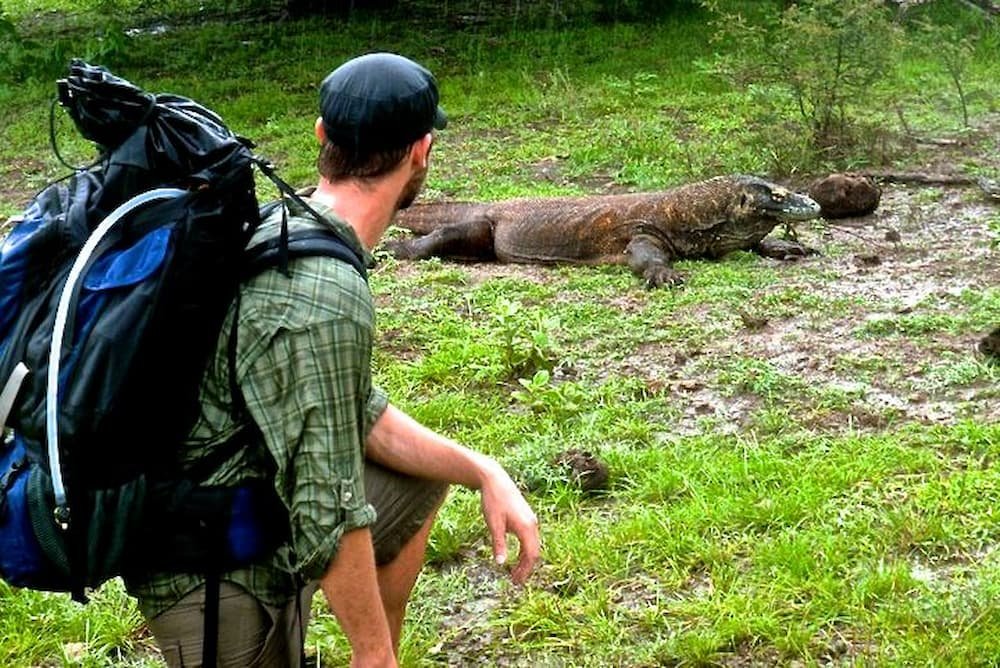
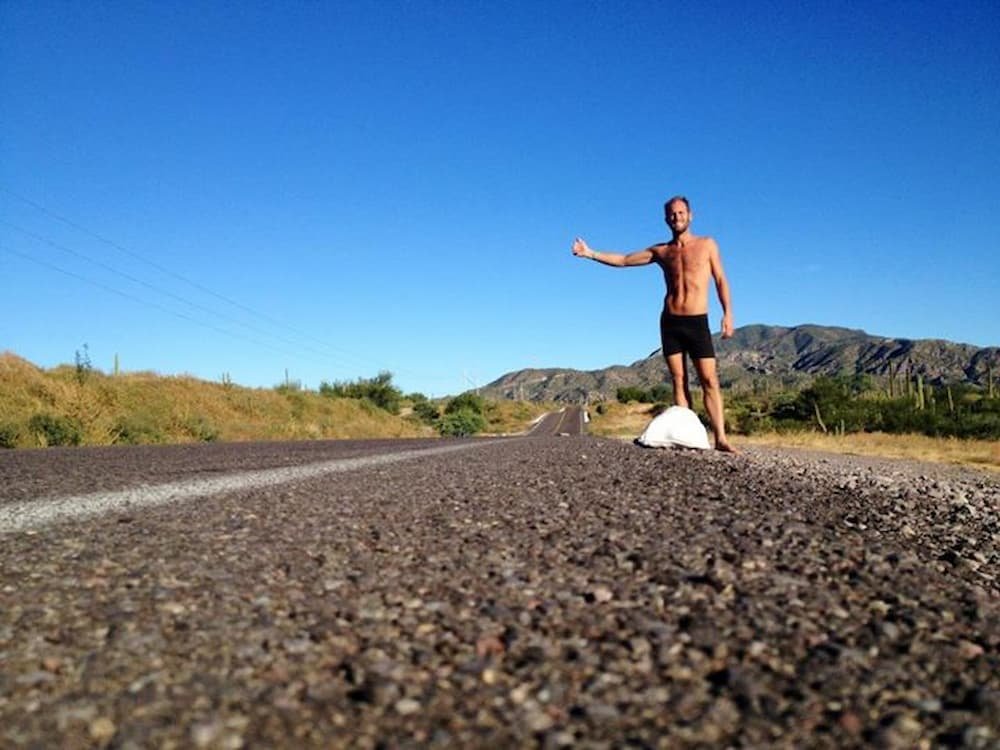
I mean seriously, when you start to get an understanding of what Pedro has been through during his travels, it’s like an onion, and Pedro’s onion has more layers than most. Not many people can say that they have hitchhiked more than 20,000 km (12,400 mi). To give you some sort of an idea of the scale, that’s nearly double the entire Trans-Siberian Highway!

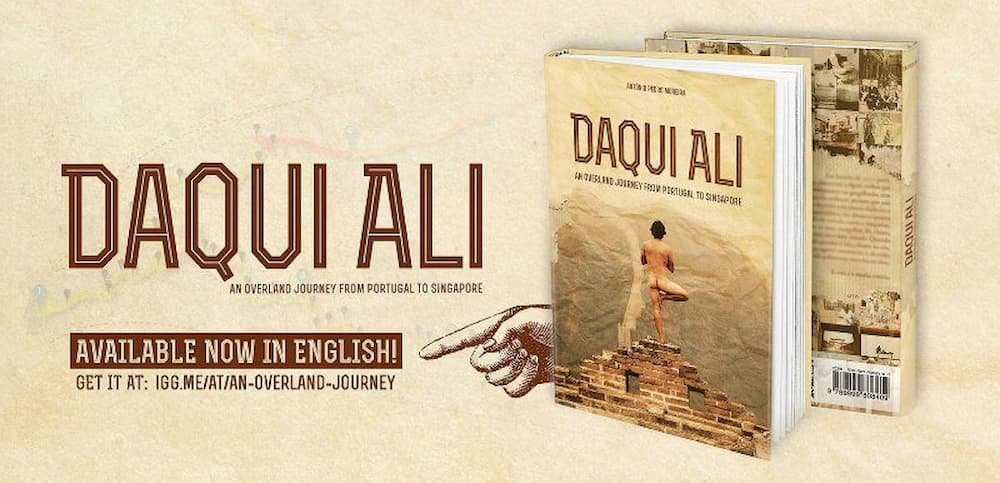
It goes without saying that an extraordinary journey makes for an incredible story, so you will be pleased to hear that Pedro has already published his first book called Daqui Ali. It’s currently in Portuguese only but you can get your hands on the English version and help support Pedro over at IndieGoGo where he is running a crowdfunding campaign.
For just €17 you get 400 pages of non-stop adventure delivered to your door. You can’t beat that! We’ve already ordered our copy. He’s already 86% of the way to his funding goal and needs us backpackers to get him over the line.
Show your support for Pedro at http://igg.me/at/an-overland-journey
Here’s a short trailer to get you wanting more..
Want to know more about Pedro and his adventures? Read more in our interview below and connect with him here on Backpacker Travel and his Facebook page.
BT: Prior to your trip to India in 2009, you were working as a psychologist in Birmingham. Had you done any significant travel before this time?
Pedro: Yes! But maybe for some people, it might seem like nothing special, and I kinda get that… when people go around the world 45 times then other trips might seem less valuable or significant. I believe a trip is as significant as one feels it. So, yeah, going on an inter-rail for 3 weeks is not as big as, say, traveling for a year, but I did feel it as something that made some impact on me. I’d also lived in Norway for 6 months and Finland for an academic year, which was something like traveling. Other than that I had visited about 30 countries in smaller trips, some more significant than others.

BT: Can you tell us of any instances where your study of psychology helped you navigate a dicey situation?
Pedro: Not really. It’s been like a LIFE long mission to understand whether having studied psychology has taught me anything in social terms or not. Because a dicey situation is still a social situation, in the sense that is happening there and then, in real LIFE. Sometimes it frustrates me a bit when I say something and I’m feeling like, “Yeah, I’m so clever” or whatever and someone comes and says, “I can tell you studied psychology.” So where’s the merit in myself?! I’m joking but it is a little bit like this at times. I believe I am good with people and usually know how to approach them. But the question is whether I’m like this because I studied psychology or I studied psychology because I was already like this. I believe it’s the latter. But yeah, of course, a certain social and emotional intelligence, be it from yourself or because you studied how to improve it, goes a long way when traveling. It served me really well with corrupt policemen in Africa… but that’s another question – literally, it’s two questions down.

BT: You ventured through a number of war-torn countries, in many cases, hitchhiking. How did your experience differ in those places?
Pedro: I’m not sure I can establish a link between a war-torn country and a certain experience that I had. Because my first instinct is to say how nice people were with me, to establish a link between war and poverty, then between poverty and kindness. But I’m not sure there is such a link if I look at things objectively. I was in Syria a few days before the revolution and then I proceeded to Iraq. From Iraq, I proceeded to Iran, a country that wasn’t and isn’t, having any war. And I can’t say whether people were nicer in one place or another because they were so nice in all of these places!
In Africa, I was in many countries that had had very violent wars in the recent past. People talked about it. There was an underlying pain but also a will to move forward, it seemed to me. People told stories and explained how brutal things had been. I had friends who were on the verge of becoming child soldiers and perhaps I met other people that actually were child soldiers but didn’t tell me. But the way they related to each other, and to me… I can’t say it was too different than in other countries that hadn’t had a war.
In Nigeria it was different. They have a big problem in the north of the country with terrorism in the shape of Boko Haram. So I crossed Nigeria from west to east cycling, in an 870 km trip and I was stopped 23 times by the police, always fearing I could be a terrorist. It had nothing to do with me looking like this or that, having a beard like this or that, because I know a Swedish guy, looking like he is from where he’s from, that had the same problems. Not only that… if in every single African country, people would shout out “Jesus, Jesus!” a million times every time I passed by, cracking up thinking they were so funny (I got used to it easily and learned how to play it to my advantage), in Nigeria, they’d call me “Boko Haram, Boko Haram!” dozens of times a day, and that sucked ass! You know, I’m a white guy living in a small town in Portugal. I’d experience xenophobia in Birmingham one time but that was that. It’s a concept that is new to me. So… even if that experience was quite heavy, to be called a terrorist all the time, it kinda opened a window for me in understanding what some people go through every day. I was in Nigeria because I wanted to be. Nobody made me, I wasn’t there because I had no money and needed to provide for my family, I wasn’t escaping a war zone. I was just this dude that had an idea of cycling to South Africa. But some people – don’t have a choice but to go to a place where they feel this kind of racist/xenophobic abuse on a daily basis! I don’t think people should go through it to understand it, but I did, and although I was never a prejudiced guy in any way, it was another stone to build a castle of empathy…


BT: Corruption is a major issue in most, if not all, developing countries. Tell us your thoughts on this and how you dealt with this ongoing problem.
Pedro: We’re talking about corruption across the board here, from the guy that gets your bags first in the airport because you paid him and someone else didn’t, to the president. In Southern Europe and other not-so-southern countries it also happens, but more on a high level.
I’m very against this, man, like most of us, I guess, and I’ll go (almost) all the way not to pay anything. And it’s not even about the money, because in many countries you can pay one or two euros and off you go, not wasting a whole hour or two standing your ground. The thing is – by paying you’re contributing to a fucked up system, you’re rewarding corrupt assholes. Also, you’re undermining the next guy, who might actually not have that money! (I know, “Who doesn’t have two euros”, one might think. Trust me – some people travel on such a low budget it makes a big difference).
Having said this – I paid when I was arrested in Laos. I’m not proud of it, but it was such a situation I felt I had no other way. Nowadays I suppose it would have been different, I’d endured it longer… but it was my first big trip, I was in jail and people back home hadn’t heard from me in a while… so I caved.
In Africa it’s different. Police ask you for money all the time. Humans are awesome. But some humans, when they put on a uniform, they turn into giant walking turds, thinking that the uniform is to be used to intimidate you, not protect you. So you have to meet them somewhere. This is where emotional/social intelligence comes in handy. Like in Sierra Leone, which was the worst country in this aspect, many policemen were absolutely arrogant evil bastards, and that intimidated me. However, I couldn’t show that they intimidated me, or they’d use it, so I acted all cool and all, but not too cool, so they didn’t think I wasn’t taking them seriously. They’d ask for all kinds of documents that I didn’t need and even arrested me one night. I spent two hours in jail and managed to get out not paying anything and not even showing my passport, let alone a letter from my government, a letter from the police in the capital, a residence permit, and all the other bullshit papers they were asking for. They were totally drunk, so they were easier to manipulate… but also more unpredictable.
By the time I got to Nigeria, I learned that the best way was to act cool (always) and take control of the conversation. They’d tell me to stop and I’d be the one asking questions. When there was a half-second break I’d go like “So I’ll see ya…” and off I went.
However, this ethical stubbornness sometimes goes bad. When I was to get into Kinshasa (the Democratic Republic of The Congo) I refused to pay a bribe… and that meant I had to go back to Brazzaville (Republic of The Congo) and that meant I had to go back home! Yep… I had a totally full passport and there wasn’t an embassy in Brazzaville where I could make a new one. I’d planned on making a new one in Kinshasa. That sucked. I flew to Portugal, got a new passport, flew back to Brazzaville and did the same thing again. This time I had to pay $20.
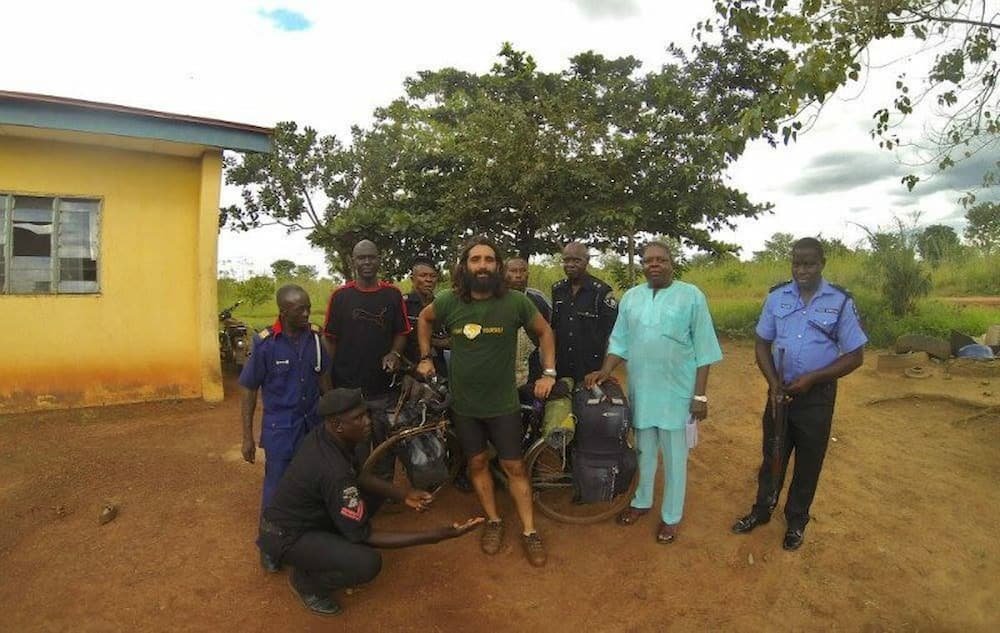
BT: Following on from that, you have been arrested on more than one occasion. What goes through your mind when you realize you’re all alone getting locked up in a foreign country?
Pedro: I was arrested in Finland in 2004 because my flatmates had posted weed from their home countries to themselves in Finland. Customs came, saw all the flags we’d stolen on drunken nights out and took us all to jail. In Croatia, we were gonna spend the night in what looked like an abandoned house, when police came and took us. In Laos, I went tubing in Vang Vieng, came back, had a blackout and woke up in the back of a van in the middle of the bush. I spent two nights in jail. In Sierra Leone, they arrested me because I “didn’t have my papers” but never locked me up, and in Nigeria, they locked me up for a few hours until someone came and assessed whether I was a threat or not.
I was pretty okay in all of these, except for the one in Laos. That was one bad experience, man. The worst of my LIFE. I don’t know whether I was drugged or what happened but for the first couple of hours, I thought I had been kidnapped. I knew I was gonna die, and that’s not a cool thing, no sir… I didn’t remember anything but knew I couldn’t have done anything really bad because that’s not me, not who I am. Some people get drunk and then violent, but I had never had a violent episode in my LIFE. So I was the victim of this scam perpetrated by the people that are supposed to protect me, the tourism police. I felt powerless and had this deep feeling of unfairness. I felt abused and almost like… violated.
But then it was over.

BT: Of the two journeys, which was the most challenging and why?
Pedro: That experience in Laos was the most challenging of my whole LIFE, but that was one thing. So I have to say my cycling journey through Africa was the most challenging. I cycled for 15,000 km in a continent famous for its scorching heat. So the physical effort was quite demanding. I had this period for about 6 weeks when, every now and then I’d start having these headaches, goosebumps, I’d start sneezing and I felt like I was dreaming… my head spinning. It’s like nothing was real. That was extreme tiredness. Also, every time I crossed a border I was always on edge because I never knew whether I’d come in contact with some asshole policeman that would catch between countries and use that to his advantage. Then the problem in Nigeria, when I didn’t feel too welcome so many times… it doesn’t mean I didn’t like the trip, I adored it, but it was more challenging, for sure.


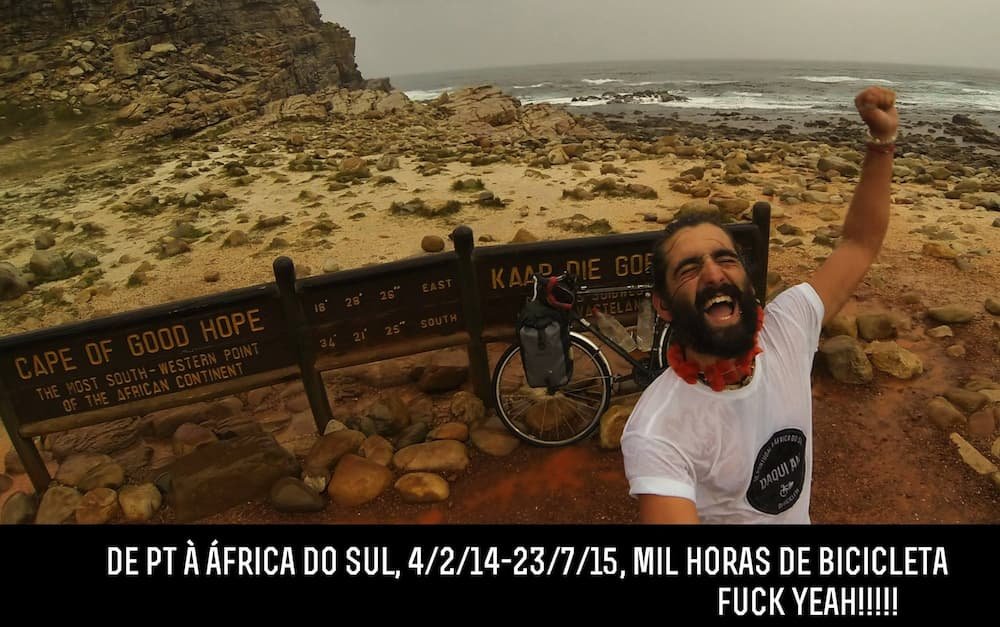
BT: The backpacking community is always looking for ways to travel cheaper and more authentically. You made it through Iraq with no money, Iran with only $35, and ended up spending around €3,000 over the entire 9 months of your first trip. How on earth did you manage that?
Pedro: Yes, I wanted to travel on a low budget for several reasons: first, because the less you spend, the more you have for the next trip, for LIFE, for whatever. Then because when you travel on a low budget you end up having experiences that are more authentic. Like being in Turkey with no place to stay because I don’t find a cheap one, asking some people whether it’s safe to sleep on the street there and ending up at their place eating, hanging out, and spending the night. You’ll also resort to Couchsurfing more which means you’ll stay with real people rather than hotel hosts. Finally, I wanted people to understand that traveling for a long period of time is possible even if you’re not a rich person.
How did I do it? Couchsurfing helped a lot. I slept for free for over a hundred nights. And on my second trip, the African one (I don’t know how much money I spent there yet) I slept for free for about 370 nights out of the 450 that I traveled. Here, more than Couchsurfing, I was hosted spontaneously by locals, a lot.
In order to save money, I also hitchhiked a lot. And if I was in a European country I’d eat supermarket food. If not, local stalls on the street, always. The €3000 also included insurance for the whole trip and a camera. I have to say I could have done it with less – I must have spent about €1000 partying.


BT: Having hitchhiked over 20,000km, what have you learned?
Pedro: I learned that usually the cheaper the car, the more likely it is they’ll give you a ride. I learned that the poorer a country is the more likely it is they’ll give you a ride. And I learned this is one of the best ways to travel. I had never hitchhiked before, we just don’t do that in Portugal.
Now I still even if I have to go to Lisbon or somewhere like that. It’s for free and I get to know someone!

BT: How did the idea for your wedding proposal come about?
Pedro: I like stories. If it has to do with my LIFE, I like nice, beautiful stories.
On my first trip, my girlfriend came to meet me in India. We’d been together for 12 years already at that time, so it was safe to assume we’d marry eventually. But how would I propose? How would I give her a nice story? Because when you love someone, if you give them nice stories, you’re giving yourself nice stories.
I had an idea about proposing in a nice place. But which one? I’d have to wait. With what ring? What if she gave me the ring that I was gonna propose with? Yeah, that seemed cool. So I hinted that I’d like to have one of those one euro rings but it’d be lame for me to buy it for myself. She got the hint and gave me one. She then returned to Portugal and I kept going. Nepal, Thailand, Malaysia, Singapore… so many nice places, but not exactly what I was looking for. Till I saw myself in Angkor Wat. That was it! I hid the ring there, kept going and when I arrived in Portugal told her I’d lost the ring at the beach. She lectured me a bit, like “You never keep the stuff I give you” but it was alright. I also told her that it’d be nice if she started saving 50€ a month and a couple of years later we could go to Cambodia, as I’d really like her to see Angkor Wat.
Time passed, and I went to Africa. After this 15-month journey, we agreed to meet in Cambodia. And so we did. We went to Angkor Wat but I couldn’t find the goddamn temple where I’d left the ring! Man, I knew it’d be hard to find the ring, I never thought I’d have trouble finding the temple! Maybe it was one of those that was under renovation. I searched for 3 days and at the end of the third, I had to give up. Luckily I had a backup ring I’d ask her to choose “for my friend’s girlfriend”. I chose a temple, sat down and explained that no, we hadn’t been looking for a certain temple because of the sunset there. I’d left something there for her. I explained everything and also told her how I want her to have nice stories about her LIFE.
She said yes.


BT: You have already written and published one book and are in the process of writing another. What led you to write about your travels and what was your biggest challenge in putting your story together?
Pedro: I’ve always loved writing. Before writing the book about my Asian trip I wrote two fiction ones. And when I left, I confess that I imagined a book would come from it. I was gonna live so much, gonna have so much… food for thought… You know, I think a lot, and I knew there would be so much to think about, I’d learn so much… and if that’s the case, it’d be almost selfish not to share it. And yeah, that’s exactly what happened. For example, I was treated so kindly in so many places most people consider scary that I felt it was my responsibility to share these experiences and defeat, even if just for a single person, some of these stereotypes.
My biggest challenge in putting my story together was to keep it short. Or not gigantic. It’s difficult to be objective in selecting what’s important when everything is important to you! So I had about 700 pages of text but eventually, I managed to bring it down to 390. I’m currently going through the exact same problem with my African book. But I’ll get there!
The other challenge was to self-publish. I didn’t like the way the publishing system works so I decided to do it on my own. Turned out great!

BT: Finally, the obvious question that we always like to ask – what’s next?
Pedro: I don’t know man… I’m getting married this year and I’ll probably have a kid next year. My girlfriend, or fiancé, wouldn’t quit her job to come traveling with me, and I’d never ask that. It’s not something you ask. If we lived in a country where jobs were easier to come by I might encourage her a bit more, but we don’t, so I don’t want her to make a decision to please me and then find herself unemployed for ages. So when and if I have a kid I don’t want to leave like for a whole year, so I’ll have to adapt my style. Maybe envision a big trip but do it 3 months at a time… There are many things I’d like to do, but I’m not really focusing on them now. I daydream, sure… but I’m living here, now, and that’s cool. The future will tell!
I’d like to thank Pedro for taking the time to chat with us and wish him all the best with his upcoming wedding.
Here are our top reads for those times you are waiting at the airport, on a long flight, bus trip or simply relaxing. We've compiled our favorite 52 books, that's enough for one per week! Where possible, we recommend downloading the Kindle version. It's not only cheaper but gives you the opportunity to have an entire library in your day pack.
Please read our disclosure statement regarding the affiliate links that are contained in this article and on the Backpacker Travel site.

Week 32
The Great Railway Bazaar

Week 33
The Man Who Quit Money
Possibly one of the most important purchases you will make before traveling is that of a daypack. This backpack needs to be your go-to accessory, capable of carrying your camera, snacks, sweater, and everything in-between.
We’ve carefully selected 10 excellent daypacks to help you make a better choice when you decide to purchase a new pack. If you are looking for something bigger, see our Top 10 Travel Backpacks for 2016.
Please read our disclosure statement regarding the affiliate links that are contained in this article and on the Backpacker Travel site.

Lightweight, durable, and secure, the Venturesafe 25L GII anti-theft daypack is ideal for use on long hikes, adventures abroad, your daily commute, and as a handy carry-on. The Venturesafe 25L GII offers a wealth of organizational options, plus an internal padded sleeve for a 15-inch laptop.

Osprey’s Axis Daypack comes with 1100 cubic inches of space for you to tote your favorite gear. Take it for an out-and-back hike and carry your water bottle, a few extra layers, and an afternoon snack. Throw it on your back for your next bike commute and clip your blinker light to the back attachment strap.

The updated Marmot Kompressor Plus pack combines wrap-around compression and ultralight performance with plush comfort and generous volume for a day of outdoor fun. And it packs into its own lid!

You want an ultralight, speed-friendly pack that will hold your essentials, so it sounds like you want the Deuter Speed Lite 20 Backpack. The wraparound compression straps minimize your pack’s profile, reduce excess movement, and keep your gear from getting jumbled, while the Delrin frame-support rod can be removed if you want even less weight and a closer fit.

The Capture 25 all-terrain backpack doesn’t just provide generous storage space and a front-shove-it pocket that offers easy access to essentials. It gives you the freedom to film every moment on your smartphone with a built-in action pocket that works hands-free. Whether it’s on your chest or on the ground, you can capture the awe of any day and instantly turn yourself into an action-in-the-outdoors adventure star.
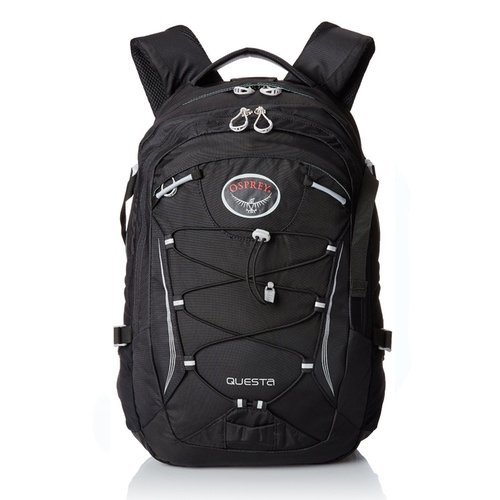
This affordable, full-sized backpack features a spacious main compartment that holds your gear and food for a week of trekking in the wilderness. Plus, its separate sleeping bag compartment makes it easy to pull out your bag without totally unpacking, and a side-access zipper lets you quickly grab gear or a puffy when the weather gets a bit chilly.

Granite Gear’s Barrier Technology provides 360-degree water repellency coverage. Our durable water repellent zippers, Taurolite material, repel weave fabric, and extreme water-resistant valuables pocket zipper shelter your gear from the elements.

Designed with hyper-durable ballistic nylon, this thick-skinned daypack doesn’t take abuse from anything. Fully-dialed features include a separate, zip laptop compartment (which fits most 17″ laptops), a dedicated tablet sleeve, and three other main compartments with plenty of space to stash essentials for a day’s outing.
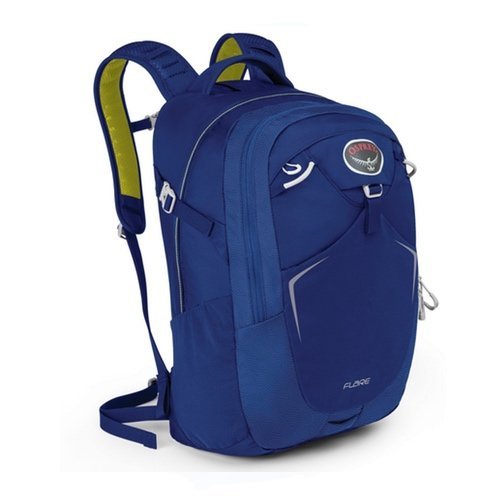
Whether you need a daypack for an excursion downtown or a walk in the woods, reach for Osprey’s Flare. The mesh shoulder harness and back panel provide comfort, even when the pack is fully loaded with gear, books, or heavy electronics. A comfortable hip belt adds extra stability under load and vanishes inside the stretch mesh side pockets when you’re traveling light.

American inspired with a modern twist – this backpack works equally well for travel and everyday use. It features a roomy main compartment with a padded sleeve to hold a 15.6-inch laptop. Two easy accesses, locking front compartments, and an organizer includes a zippered RFID blocking pocket. Anti-theft features have slash-resistant construction, locking compartments, and slash-resistant adjustable straps that will keep you and your belongings protected.
So you’re thinking about setting off on the journey of a lifetime, well, you’re going to need a sturdy backpack that’s able to carry all your gear. Luckily, we’ve done all the hard work for you, researching and testing a bunch of options to bring you the top 10 backpacks for travel below!
Any of these packs will be an excellent addition to your gear, and make sure to check out our Top 10 Daypacks of 2016 too.
Please read our disclosure statement regarding the affiliate links that are contained in this article and on the Backpacker Travel site.

With specialized fabric that protects from slash-and-run thefts, the VentureSafe 65L GII Travel Pack from PacSafe lets you see the world without having to keep an eye on the gear in your pack.
This pack also comes in a smaller Women's 55L model

The Deuter Act Lite 65+10 Backpack’s Aircontact Lite system supports heavy weekend loads while providing continuous airflow and a comfortable fit. The anatomically shaped X-frame distributes weight equally on your shoulders and flexes with your movements, so you can focus on the hike instead of your pack.

The North Face engineered its Terra 65 Backpack with the easy-to-use Optifit suspension system to give you a fully adjustable fit before you hit the trail for a weekend. An included tool measures the length of your back so you can match the Optifit system in the backpack to your exact measurements.

Gregory gave the Baltoro 65 a hefty helping of cargo capacity and a supremely comfortable suspension system so that even when the pack is fully loaded on a one, two, or three-day trip, it will offer stable support for mile after mile.

Bring everything you need without checking a bag. Suitcases aren’t up to the demands of city travel. Hiking packs are disorganized and too big to be carried onto a plane. International travelers like you need the right luggage.

This affordable, full-sized backpack features a spacious main compartment that holds your gear and food for a week of trekking in the wilderness. Plus, its separate sleeping bag compartment makes it easy to pull out your bag without totally unpacking, and a side-access zipper lets you quickly grab gear or a puffy when the weather gets a bit chilly.

Capacious enough to easily accommodate a week’s worth of gear, the Osprey Porter 65 Backpack also is versatile and impressively mobile. You can sling it over your shoulder in a mad dash from bus to plane or don it like a full-on backpack for the trek to gate Z99.

The Osprey Exos 58 Backpack has space for your backpacking trips in summer and ice climbing trips in winter, and it’ll carry your gear without adding excess pack weight to your trip. A combination of the AirSpeed back panel and the light yet durable 6065 aluminum frame brings a lot of breathability by dumping excess heat out of the sides.

The bestselling Osprey Aether 60 pack just got even better with an updated design and a stiff, well-padded hip belt. You’ll be amazed by its lightweight, support, comfort, and highly customizable fit.

Ready for your next plane trip, the lightweight REI Vagabond Tour 40 Travel Pack has a comfortable backpack-style harness that stows away neatly when it’s time to slide the pack into an overhead bin.
In partnership with Dive.is
If you’ve ever been snorkeling or scuba diving before, it’s a fun and indescribable experience. You’re aided by a snorkel or an oxygen tank to breathe while exploring what’s underwater and marveling at the life below.
For many people, snorkeling or scuba diving in Iceland is not the first thing that springs to mind – obviously, because it’s so cold. But in Iceland, you can snorkel in the only place in the world in between the North American and Eurasian continents, which drift apart about two centimeters every year.
Be brave, the water might be freezing but it’s well worth taking a snorkeling tour in Silfra, Iceland.

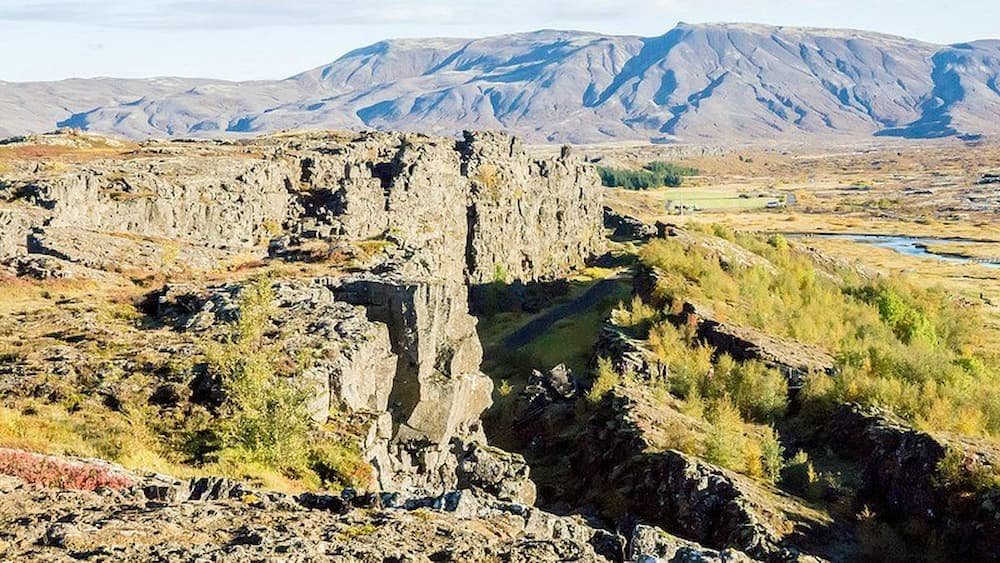
The Silfra fissure is the crack between these two continents, and where the water averages a chilly two to four degrees Celsius (yes, it’s pretty much freezing)! We arrived at Silfra, not far from the UNESCO World Heritage site Þingvellir, which we could see from a distance and which we had visited only a couple of days before.
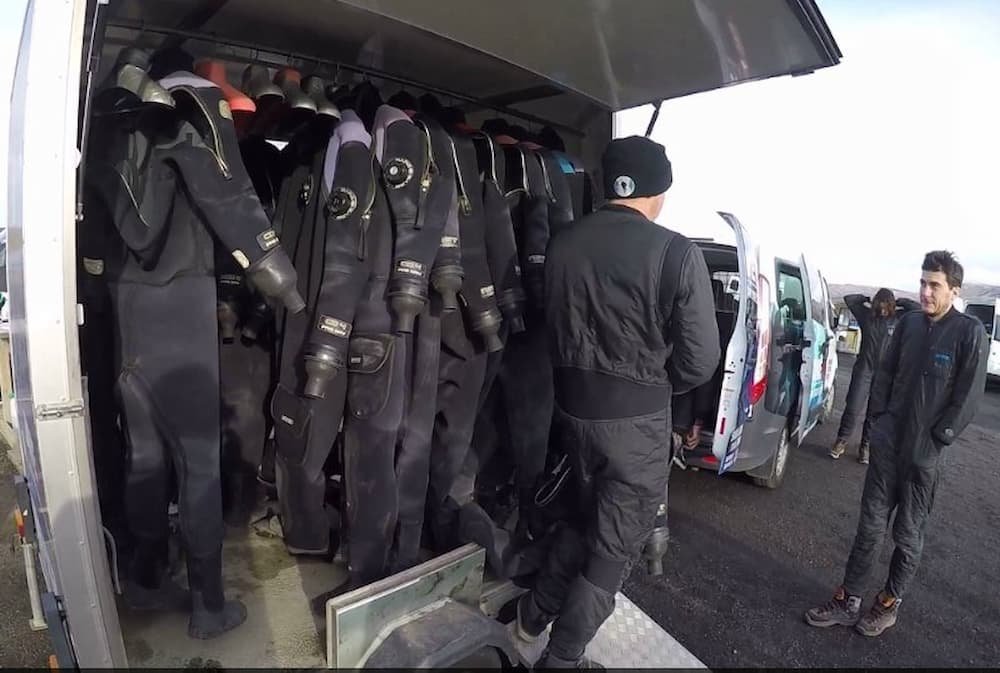
Once we arrived at Silfra, we put on a dry suit over our clothes, which was light and so comfortably insulated that we didn’t want to take them off. On top of that was our hooded wetsuit, plus our snorkel and goggles. We had two pairs of socks over our boots and flippers and waterproof gloves to top everything off. The only thing that was exposed was our faces.

Our group of friends clambered down a few steps leading into Silfra fissure, and even though we were more than adequately insulated, as soon as my body touched the water I could feel the cold water surrounding me. Once my face was in the water I was admittedly shocked by the cold, but too exhilarated to care. Here we were, bobbing up and down in the water, seeing the colorful rocks and landscape underneath with incredible clarity – we could see 100 meters ahead. The water was so clean, that if you wanted to you could take a bit of a sip of it (I tried it – the guides even recommended we do it).

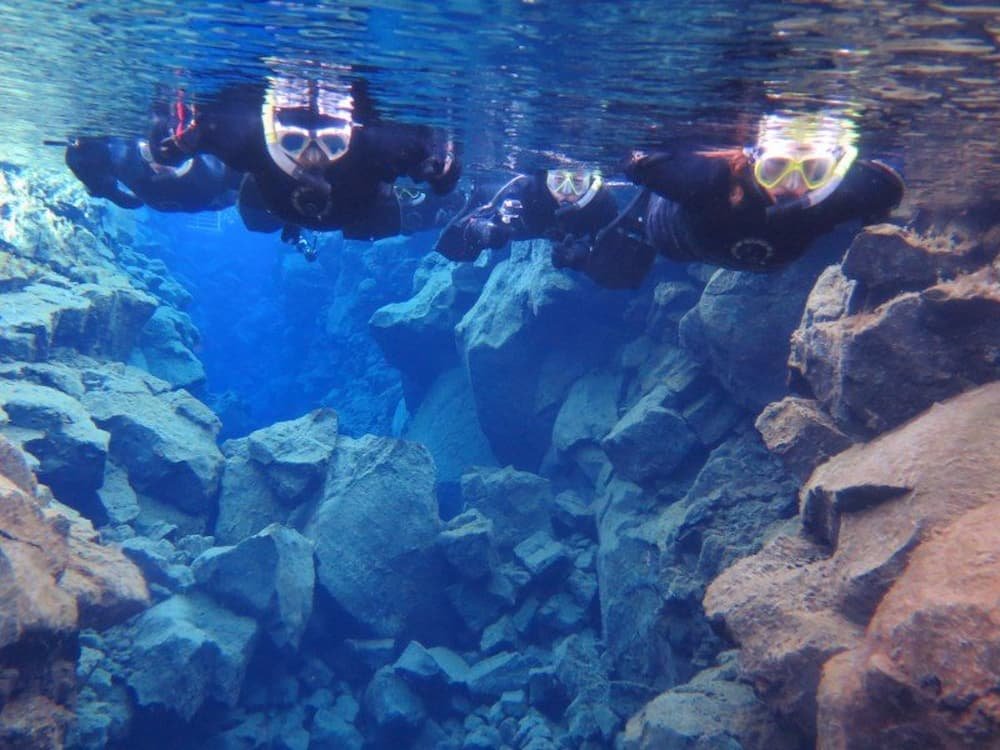
There are several sections of Silfra, with the deepest being Silfra Cathedral, which is 20 meters deep and 100 meters long. Here we saw lava rock walls dramatically sloping downwards, as well as algae. At the narrowest part of the fissure, you could practically touch the tectonic plates on either side of you. The last section is Silfra Lagoon, where the fissure widens out and we were able to freely swim around and explore.

While you don’t see any fish in Silfra, the experience itself was so unique and fun. Towards the end of the experience, I could feel my fingers chill and freeze, so I wouldn’t have stayed in much longer than the time they had given us about 30-40 minutes, which was perfect. Before you go in, the guides tell you that your fingers, while covered, will inevitably get wet, and the best way to avoid them from getting colder is not to move them much – so either swim with your hands behind your back, or outstretched in front of you (which looks kind of weird admittedly, but I did that because it was the most comfortable).

Once we got out of the water, I could tell that my face was flushed from the cold and my lips, which had been wrapped around the snorkel the entire time, felt swollen and numb. Talking felt hilarious. We walked back to the van to change out of our wetsuits (which was quite an endeavor itself) before being treated to hot chocolate and biscuits – the best way to finish up a one-of-a-kind experience.
If you would like to dive or snorkel at the Silfra fissure be sure to check out Dive.is.
Don’t be fooled by her small stature, Tara is an Irish pocket rocket! This little bundle of energy surely knows how to travel too. It all started in 2011 when, as a 23-year-old, she moved to South Korea to teach English. Tara was instantly hooked on the new cultures, traditions, and foods. Fast forward two years and she set off on a backpacking adventure that would span 12 countries, beginning in Finland and ending back in South East Asia.

Not intimidated by the unknown, Tara enjoys traveling to destinations that are a less-frequented, including Tibet, Myanmar, Mongolia, and North Korea. She fell in love with the world beneath the sea on a trip to Thailand and achieved her open water diving certificate not long after. This newfound freedom struck a serious cord.
In 2014, she moved back to Ireland for work but found herself longing to hit the open road again. It wasn’t long before an offer came up to go back and teach in Myanmar and she jumped at the opportunity. While that particular contract turned into somewhat of a nightmare, it provided the stepping stone to looking for work back in South East Asia.
Since returning, she has completed her dive master’s certification and now works as a divemaster in Koh Tao, Thailand, and couldn’t be happier.


Want to know more about Tara and her adventures? Read more in our interview below and connect with her here on Backpacker Travel. You can also follow her on Instagram at @tarapower8
BT: You’ve traveled quite extensively through South East Asia, what’s your favorite experience thus far?
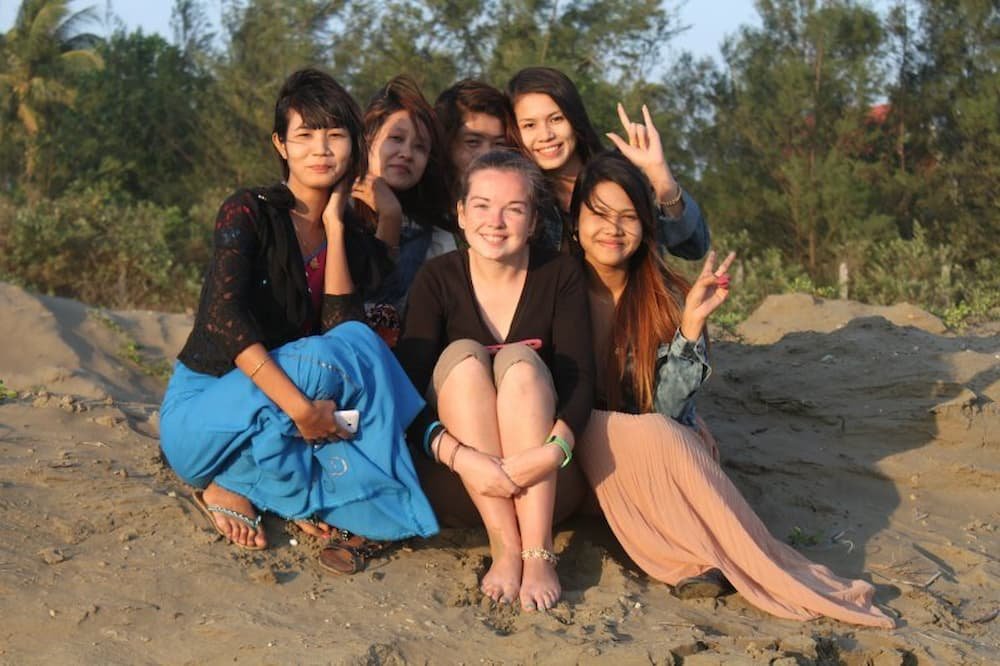
Tara: I’ve had a few amazing experiences but visiting Mrauk-U (pronounced meow-oo) in Rhakine state, Myanmar was one of the best. I backpacked Myanmar and there were always other backpackers around but in Mrauk-U I was pretty much alone. I did meet other backpackers but we all went our own ways. Here I got to interact with the locals, meet families, visit homes, and pagodas and of course, see a place in Myanmar that was not touched by tourism at the time.

BT: What inspired you to start working abroad?
Tara: I always wanted to live and work abroad. There was always something holding me back, like university, my job, or a boyfriend. Then a good friend of mine left to teach English and his stories about living in South Korea made me a little jealous so curiosity got the better of me! I researched the life and work over in South Korea and applied for lots of jobs and 6 months later I was on a plane bound for Seoul! One of my best decisions.

BT: Are there any particular life lessons or moments of clarity you have experienced on the road?
Tara: I am a social person. I love being around people but I learned on the road how important personal space is. Traveling by yourself is great because you are open to meeting new people but it also teaches you about how to be alone as cliche as that sounds! I really enjoy diving as you don’t need to talk during it. You only use signals.
BT: You recently attained your divemasters certification, have you taken anyone on their first dive yet? If so, has anyone freaked out on you?
Tara: Yes I’ve taken newly fledged open water divers out for fun dives. People have had problems while under the water with me. The important thing when dealing with divers is to properly brief the buddy teams before you ever enter the water, so they know how to act or signal when they have a problem.
When I dive I spend a lot of time swimming on my back watching to see if everyone is ok.

BT: What’s the most exciting dive that you have done?
Tara: One of the first times I ever led a dive was in Chumphon Pinnacle near Koh Tao in Thailand and I was leading some new DMCs (divemaster candidates). We were heading back to the buoy line as it was nearing the end of the dive when there was lots of noise under the water – LOTS of tank banging.
As I swam around a piece of rock and there was a whale shark right in front of me! We all start celebrating under the water and whooping. It was everyone’s first whale shark sighting! Everyone on the boat was so excited! I even got a local artist to draw a whale shark in my logbook so I could remember the day!


BT: If you had to choose just one cuisine to eat for the rest of your life what would it be?
Tara: I really love Korean food and I’m craving it right now so I will go with that. But, it changes day by day!

BT: What’s one item you always pack but rarely use?
Tara: My parents will kill me but suntan lotion! I always forget to put it on and I am always burned! As I spend time in the water I don’t put suntan lotion on my skin as it is harmful to the coral.

BT: As a solo female traveler, have you ever felt unsafe or threatened while traveling?
Tara: The one time I felt unsafe was in Tianjin in China. I was making my own way to the hostel but the directions got me lost (I was following them but still managed to get lost). A kind guy hailed me a taxi and told me I should pay a small amount as it was not far. The taxi driver brought me as close to the hostel as possible and then tried to screw me out of money saying it was a night charge. The amount he was asking for was higher than the meter. I said no (the charge should be on the meter) so he took my backpack and tried to drive off with it, then threw it in the middle of the road causing traffic to stop.
A crowd soon gathered and proceeded to call me every swear word under the sun. I ended up giving him the money as he threatened to hit me several times. Unfortunately, greed is everywhere when you backpack. If possible get where you want to go in daylight, it often makes things easier.

BT: What one tip would you give to young girls wishing to get out there and see the world?
Tara: Feed your curiosity and go with the flow and don’t let anyone hold you back. Also, don’t forget to use your head so you won’t get into any difficult situations!
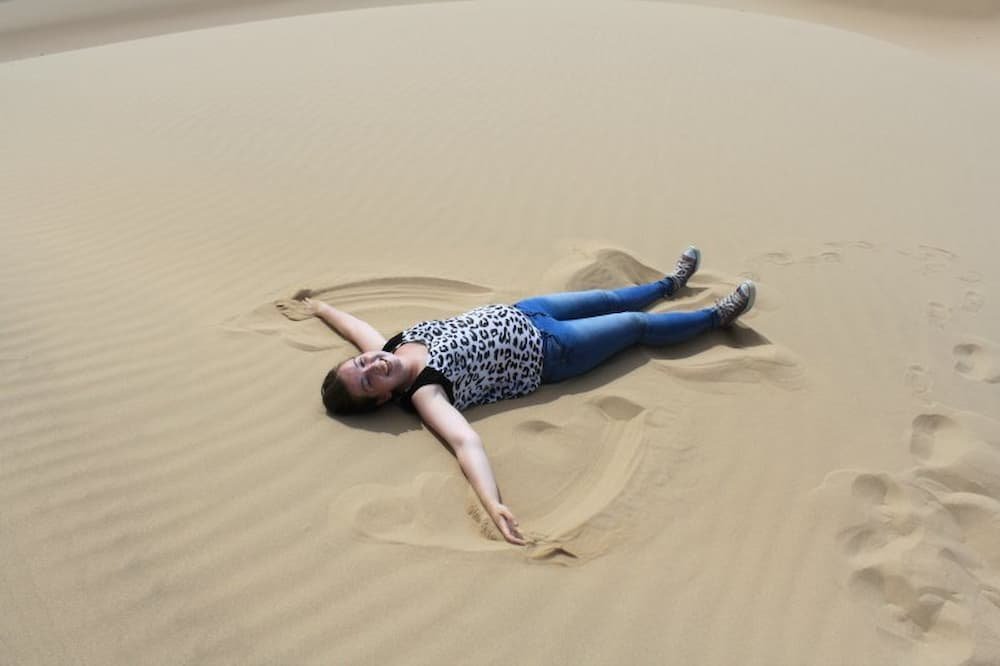
It’s not too often that you get to meet someone who truly challenges your outlook on life and makes you want to make a difference. Rob Greenfield is one of those people and we got to have a chat with him about his philosophies on sustainable living, travel, and a bunch more.
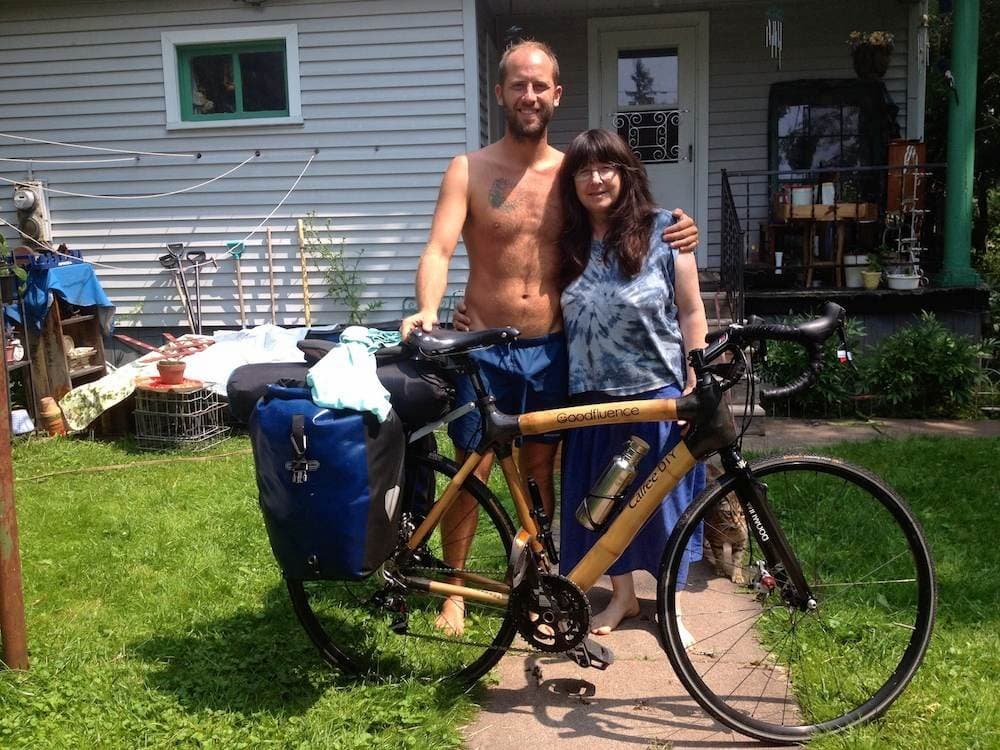
Rob’s life could be considered pretty extreme. Some would call him a hippy, living a simple self-reliant existence and dedicating his life to education and giving back, both to the environment and the people he meets. This scruffy-looking guy has traveled the world sure, but it is his positivity and desire to make a change in the world that drew me in.

He wasn’t always an environmentalist though…. as you can see from the timeline below, he was your average teenager. Rob had your typical aspirations – “I wanted to be rich and to own lots of really impressive things”. After traveling the world he says he “… gained an appreciation for how diverse and immense the world is and a desire to protect it”.
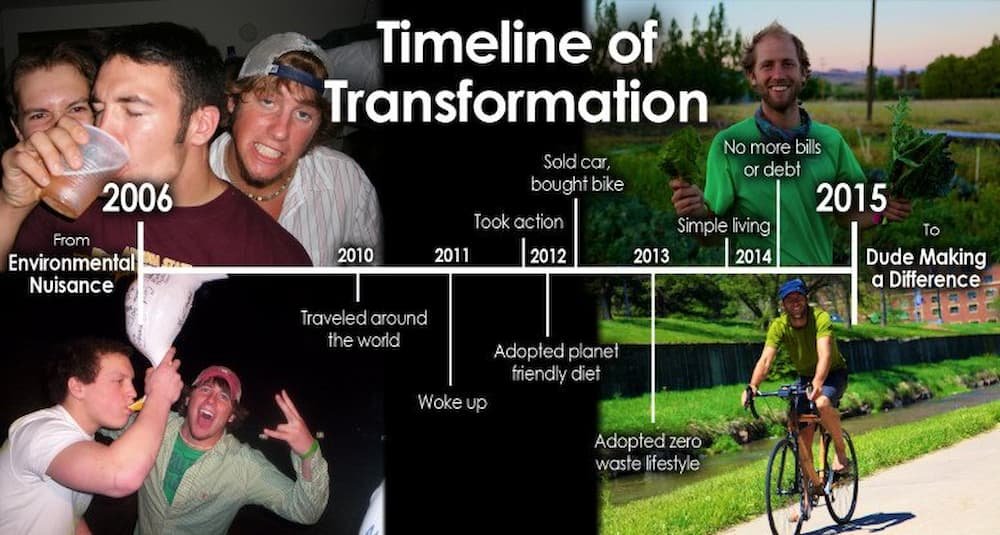
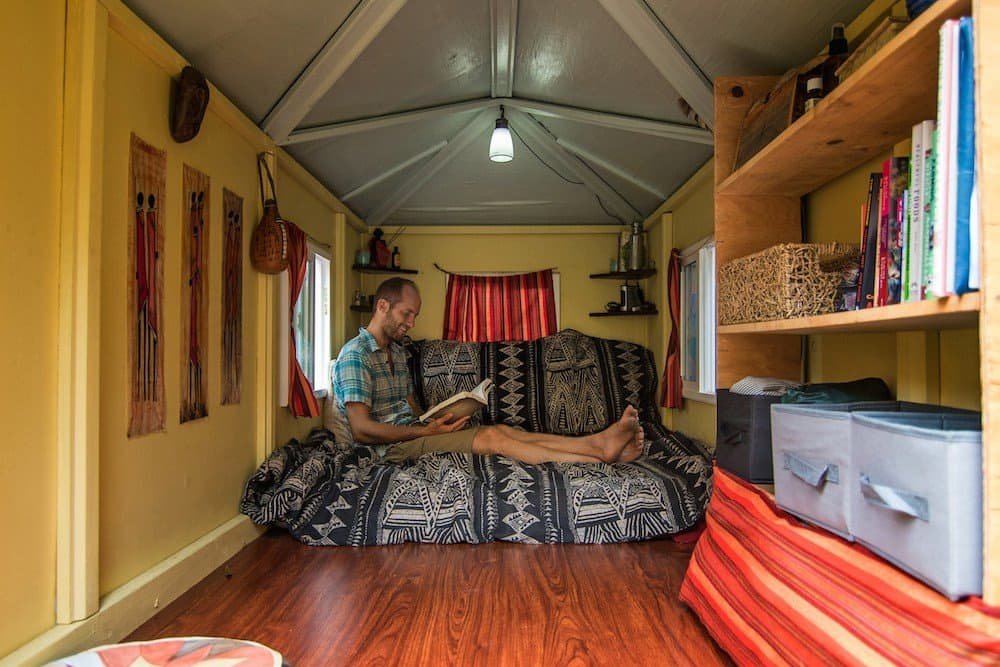
In the following five years, he sold his car and bought a bike, downgraded his possessions, got a vasectomy, bought a tiny house and started his new life.
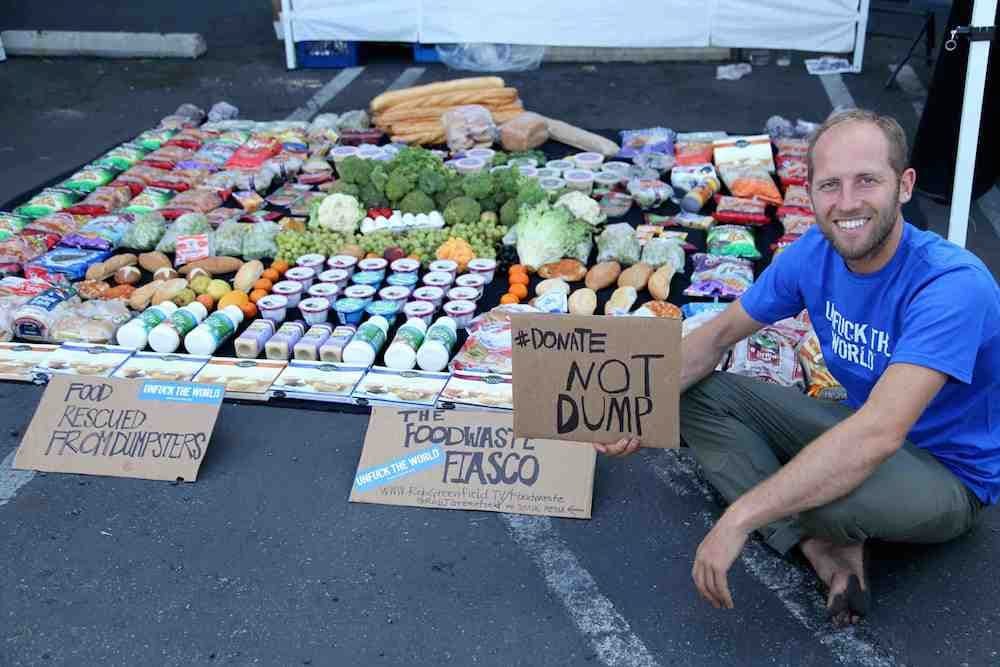
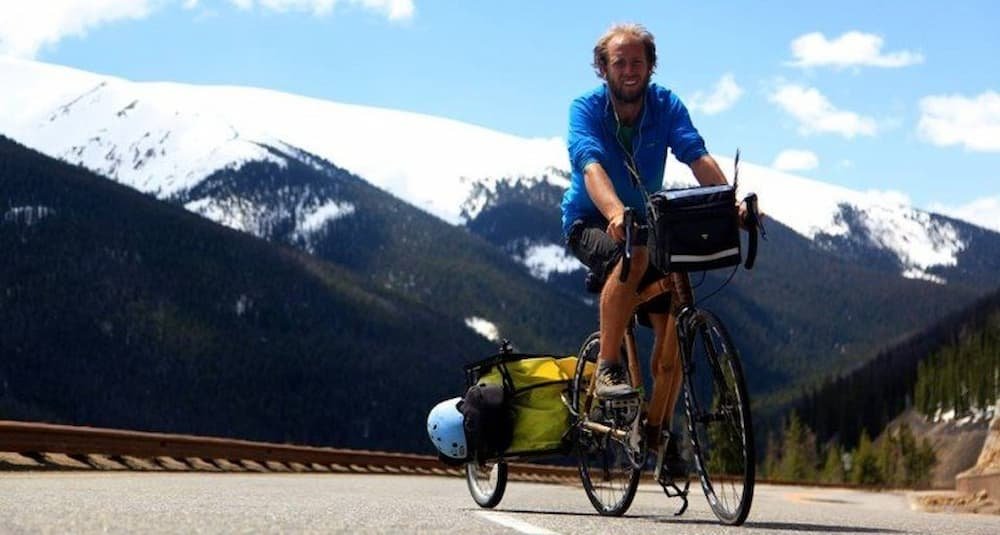
Rob has ridden 7,563 kilometers (4,700 miles) across America, often eating from supermarket dumpsters, in an effort to bring attention to the enormous waste of food in today's society. In 2011, he created The Greenfield Group, a marketing company with a sustainable initiative.
Since then, Rob has gone a year without showering and vowed to donate 90% of any money he makes to non-profits. His story has been covered by many of the major media outlets as he spreads his message of ‘doing good’.
He is also an avid adventurer, setting challenges many would never dare. One of these ‘challenges’ involved flying to Panama City with just the clothes on his back and his passport. He managed to make his way back to his home by taking on odd jobs and through the generosity of the people he met along the way. All this, through countries that have a bad public reputation when it comes to traveler safety.
That’s exactly what he loves doing – education by breaking misconceptions.
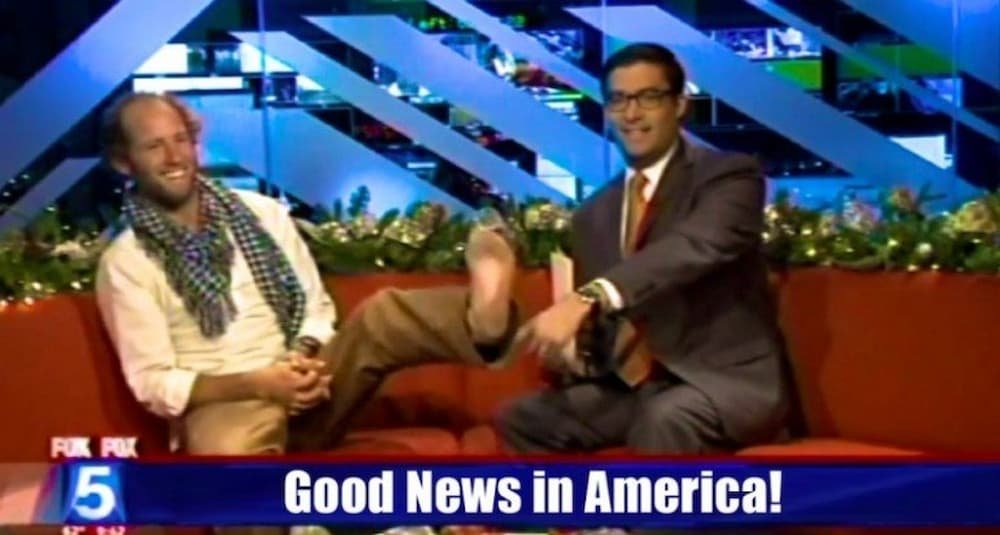
BT: Your driving passion to ‘do good’, how did that all get started?
Rob: In 2011 I started to watch a lot of documentaries and read some books and realized that things aren’t all going so swell on earth. I learned that so many of my little daily actions were causing destruction to the earth around me both near and far. I decided I didn’t want to do that anymore so I had to unravel my life and then put it back together in a way that aimed to be beneficial to the world rather than harmful.
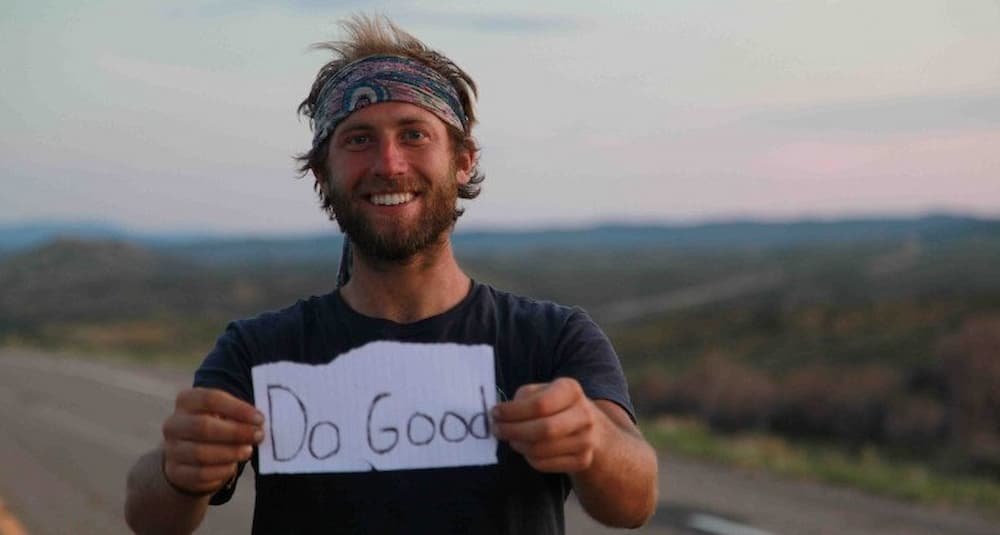
BT: What’s the most rewarding thing about the way you are living your life? Is there anything you would change?
Rob: What I find beautiful about my life is that I no longer live a life of separation. I don’t have a different ‘me’ that I put on for business, for family, and for friends. I am myself no matter where I am and this is a huge relief. I have nothing to change in my life right now.
BT: Can you tell us a little more about the causes are you currently promoting or involved with?
Rob: I make sure that I don’t get stuck into just one cause because I want to always look at the greater picture of what is going on. My overall goal is to wake people up to how our lives impact other people, other species, and the earth as a whole. So I focus on all the things we deal with on a daily basis including food, water, energy, waste, and transportation. I do a lot to inspire people to ride bikes and drive less, grow food, eat a plant-based diet, and live a less wasteful life to give you a few examples.
BT: What habits can we as travelers change to be more environmentally conscious?
Rob: I just wrote a guide on my blog called: How to Reduce your Impact when Traveling. It’s a must-read for anyone with that question. My greatest (and most fun) suggestion would be to plan adventures that are designed to be more earth-friendly in the first place such as traveling from organic farm to organic farm, volunteering on environmental projects, cycling across your country, or going on a great hike!
BT: What does living off the grid mean to you?
Rob: The definition of off the grid is “not dependent on public utilities, especially the supply of electricity.” That’s me spot on right now. I harvest rainwater for all of my water needs and have solar panels to create my energy. I have no connection to the water or energy grid. Those are the fundamentals of being off the grid.
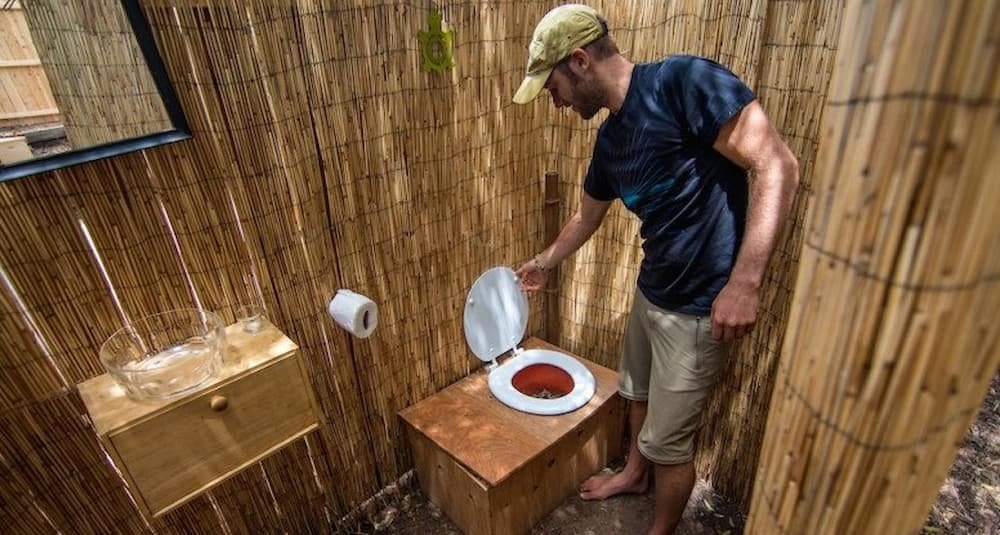
BT: Is it true that you haven’t showered for over two years?
Rob: Yes! Instead, I go for a swim in a natural body of water. The Pacific Ocean is cold right now so it’s a bit of a chore but it’s something I really enjoy. If I don’t go to a natural body of water I’ll use about a half-gallon of water from the sink. January 15th is my 1,000th day without a shower and I’m thinking about ending the streak. We’ll see though.
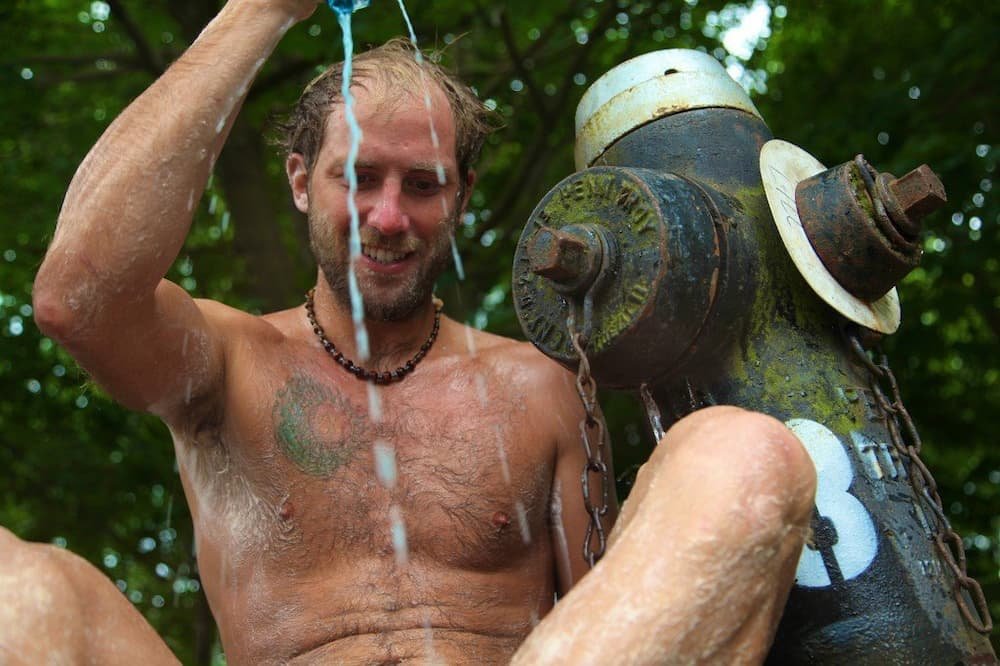
BT: You are an advocate of ‘dumpster diving’, can you tell us a little more about that?
Rob: Actually I’m primarily an advocate of not putting any food in the dumpsters in the first place. 1 in 7 Americans are food insecure while we waste enough food to feed another entire American population. Children are going to school hungry, too hungry to concentrate on studies, elders are at home with seriously rumbling stomachs, all while $165 Billion worth of food is wasted per year in my country. I dumpster dive to create visuals of how much food is wasted and encourage this food to be donated rather than dumped.
This video shows pretty well what I’m up to:
BT: It seems you live a pretty nomadic life. What effect has that had on your relationships?
Rob: I have no strain on any of my relationships. I am present with the people I am with while I’m with them and I have countless healthy relationships. I don’t get beef from anybody that I’m not around so everyone seems happy just to spend time together when they either visit me or I visit them.
I have a girlfriend and we recently spent 75 days on different continents. It was tough but well worth it.
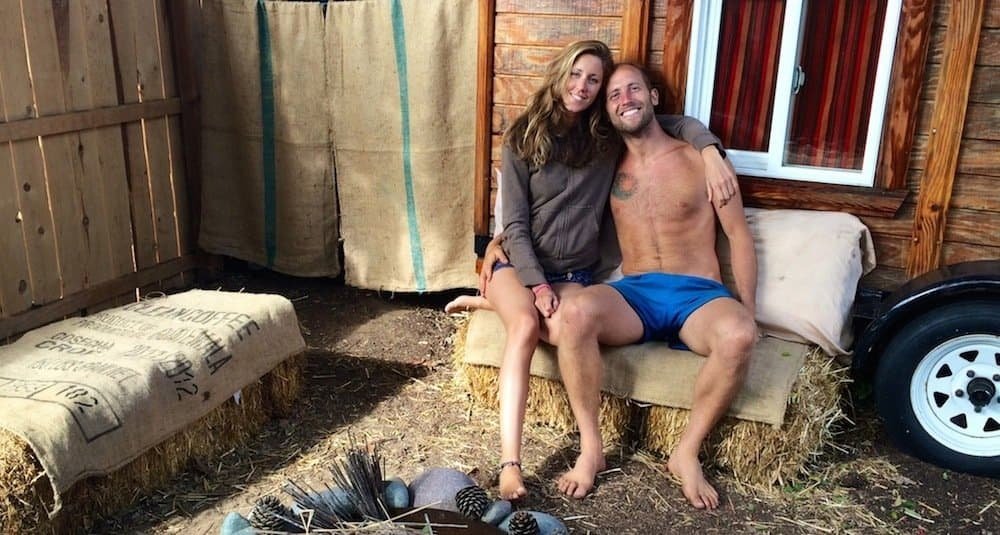
BT: Many of your major adventures have taken place throughout the United States yet you have traveled extensively around the world. Do you recommend people step outside their own country and if so, why?
Rob: I absolutely recommend that people travel outside their own country. I think most racism, sexism, religious segregation, and fears of other cultures stems from a sheltered life and not branching out beyond what a person knows. Traveling the world has the ability to shred that apart in a matter of months and turn someone into an accepting and compassionate being.
Traveling, in my opinion, is absolutely one of the best investments someone can make with their hard-earned money.
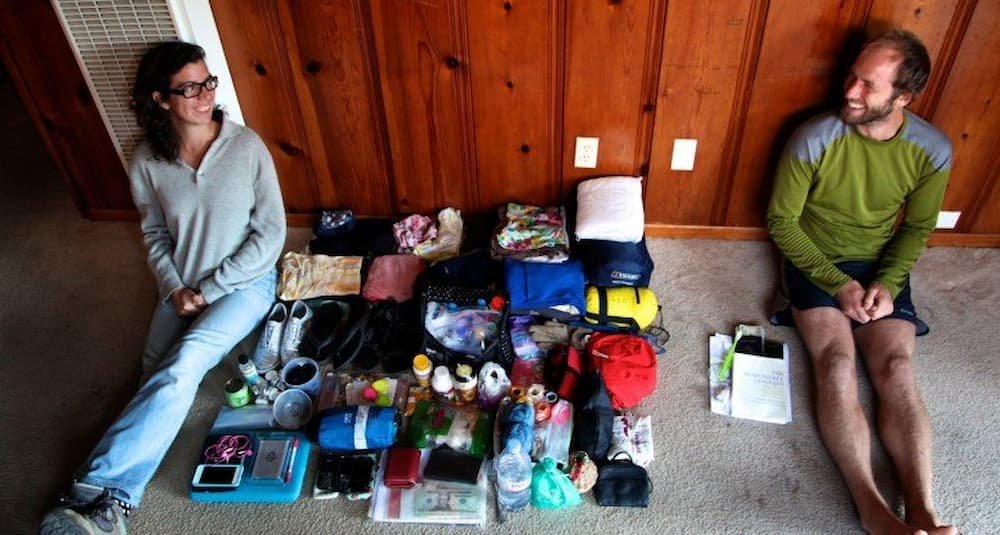
BT: Finally, many people are looking for ways to cut their costs when they travel. What tips can you give the readers for traveling on a tight budget?
Rob: Here are a few quick tips:
Read my full guide here: RobGreenfield.tv/travelfree
BT: Ok so you’ve cycled across America and visited six continents, what’s the next adventure in store for Rob Greenfield?
Rob: My girlfriend and I are going to be traveling Central America for 3 months and then the USA (and the world) indefinitely starting this spring. I plan to be in the service of others that I meet while expanding my own horizons as well.
Originally hailing from Chicago, Chris moved to Seoul in early 2008 as, you guessed it, an English teacher. Always keen on trying new things and experiencing the local culture he spent his downtime frequenting local festivals, steadily exploring more obscure destinations around South Korea.
In the five years of living in South Korea, he met the love of his life, got married, and authored numerous books for foreigners wishing to learn more about the country.

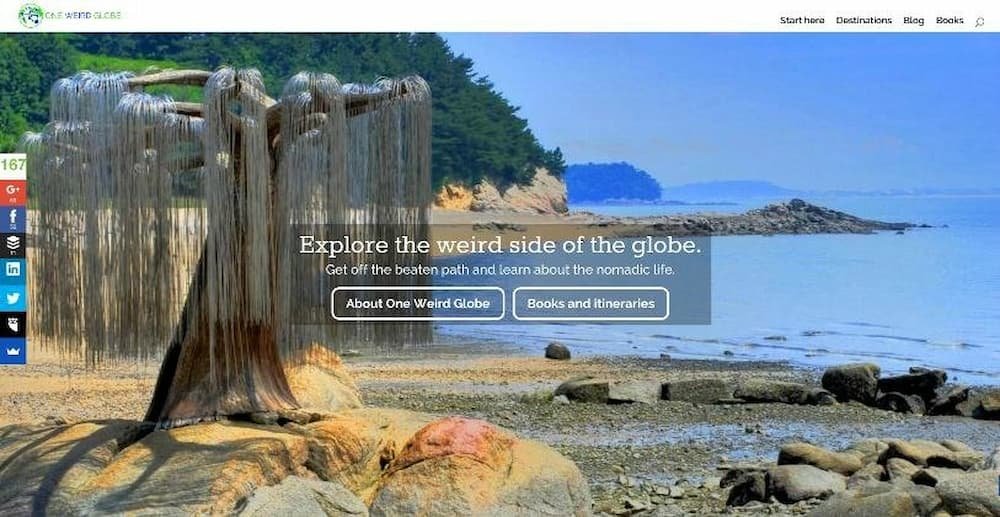
Attracted to the weird, wonderful, and outright bizarre attractions that the world has to offer, Chris created the website One Weird Globe. Right now the content is heavily focused on Asia, featuring things such as hell temples, museums dedicated to toilets, phallic shrines, and a whole lot more.
Today we had the chance to chat with Chris and find out a bit more about his nomadic lifestyle.


BT: First off, please tell us what drew you to living a nomadic lifestyle.
Chris: If you had told me in 2008 (when I moved to Korea to be a teacher) that I’d be living abroad as an expat/nomad, I’d have asked you for your supplier. After a few years of living in Korea, I began to see the world as my oyster. Everyone says that at college graduations and such, but few even get the passport necessary to rock it.
We move to a new city (and sometimes country every 3-6 months these days, after spending 5 years in Korea and 2 years in Thailand. Since we’re more likely to stay as tourists now (and less likely to jump through the hoops of a business/education visa unless it’s really the only way forward), that tends to limit the time we have.

BT: What training & qualifications (if any) did you need before working as an English teacher in Seoul?
Chris: At the time, you needed a Bachelor’s degree in any discipline, teaching experience was desirable but not required, you had to like kids, and you had to be willing to relocate to Korea. Things have tightened up a bit since then – there are a lot more native English teachers living in Korea now, so most schools don’t perceive as much a need to hire from abroad. If you’re looking, be prepared to show certifications – Koreans love those.

BT: Why did you decide to start writing? How did you get started?
Chris: My friends in the US were a bit surprised I was moving to Korea. More than a few people asked if they had internet ‘over there’. I said I’d keep a blog about the travel and adventures of living abroad. This was 2008, so not everyone was doing that yet. A couple of years in, I began to realize a lot of people were reading it – without promoting it I had several thousand hits a month, which grew to as much as 50,000 hits a month at one point.
BT: Are you making a living off your blog? If so, how long did it take before you started to see results?
Chris: 2016 will be the year it happens! There’s a ton of money-making strategies with blogs, and to be honest it was never a super-high priority considering the ways most of them worked. Either you’re making a bit of coin from sponsored posts (which risks getting your site penalized by Google) or banner ads (which people are blind to)… I haven’t nailed this one yet, but I’m going to.
BT: You now seek out ‘unusual experiences’, what’s the most unusual thing you’ve done?
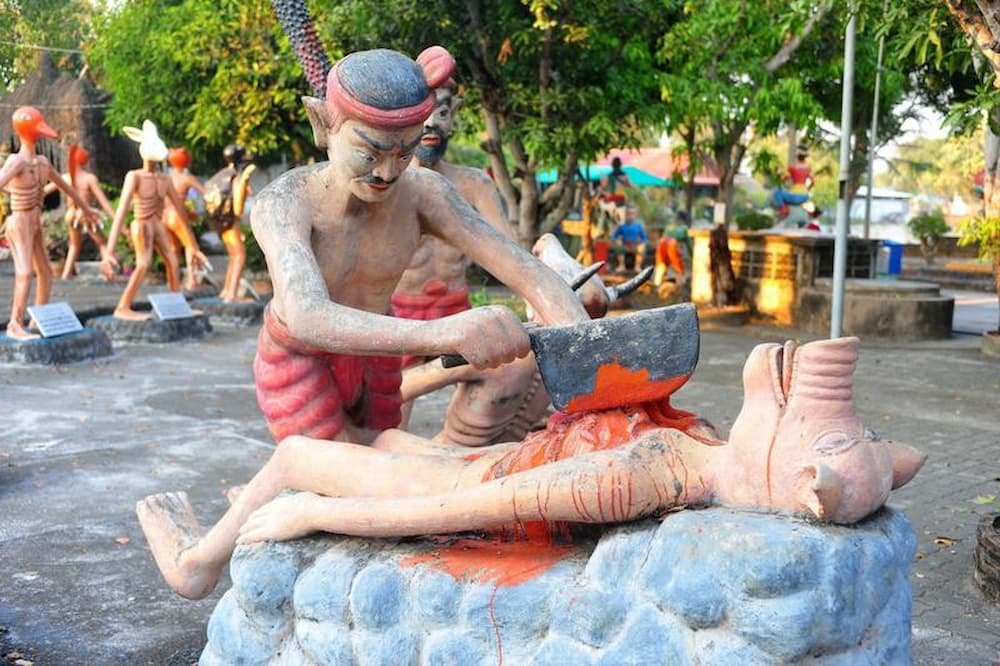
Chris: In 2013, I re-branded from ‘Chris in South Korea’ and ‘Chris in Thailand’ after realizing I didn’t want to start a new website for every country I lived in. They got merged into ‘One Weird Globe’, and the focus shifted to the weird, the unusual, and the bizarre. The most bizarre place thus far? Probably some of the hell temples around Thailand (be aware some of these posts are not suitable for work). The umbilical cord shrine (suitable for work) gets an honorable mention as well.

BT: Now that you are married, what is the biggest difference in the way you travel?
Chris: No more strip clubs? LOL. There’s a natural adjustment you make whenever you begin traveling with someone on a steady basis. We started taking weekend-long trips while we were dating, realized our styles were a great fit, and for the most part wanted to go to the same sorts of places at around the same pace. This is important – if one of you wants to go hiking while the other would rather peruse an art museum, you’ll have to adjust to make both of those happen.
To be sure, one isn’t necessarily better than the other. I had a blast traveling while single, traveling while dating, and am having a blast traveling while married.

BT: How did you find living in South Korea as a foreigner? Were there any challenges that you experienced and if so, how did you overcome them?
Chris: South Korea is as first-world as anywhere else in the world. It’s super-easy to get around, you can learn the crazy-looking alphabet in a matter of hours, and there are tons to see and do.
That said, the hierarchical / Confucian structure puts you as a foreigner near the bottom of the totem pole. A lot of foreigners have issues with passive-aggressiveness coming from the locals, or seemingly innocent questions that mask more than a bit of ignorance (“Can you eat spicy foods? You can use chopsticks?”). The average English level is… lacking, making it difficult to have a lot of meaningful conversations with locals.
Most expats adjust by learning Korean or hanging out with expats / other native English speakers, and every expat I met in Korea that had been around for a while found a way to vent/blow off steam that didn’t jeopardize their job. Joining a band, taking pictures, writing… they’re all good ways to get your mind off that crazy kid in your class…

BT: You recently moved to South America, what is one thing you miss about living in Asia?
Chris: The bum zapper! It’s a culture shock moment for many Westerners when they enter a public bathroom and don’t see toilet paper inside. Just a water jet. They approach it… gingerly… and a surprising number begin preferring it. I’ve only seen it in Asia, but you end up feeling cleaner with less of a potential mess on your hands.

BT: How has living overseas changed your perception of the world?
Chris: You have to get outside the system to see it objectively. Whether that system is, say, American news, or the way in which locals treat foreigners, it’s far easier to see how things get twisted/distorted/biased. I’m far more open-minded about different ways of working, living, and adjusting to how things are.

Greg and Emma are a couple who live in Sydney, Australia. Greg was raised down under while Emma migrated from the United Kingdom. Drawn to travel and adventure at an early age they started working in the travel industry not long after leaving school.
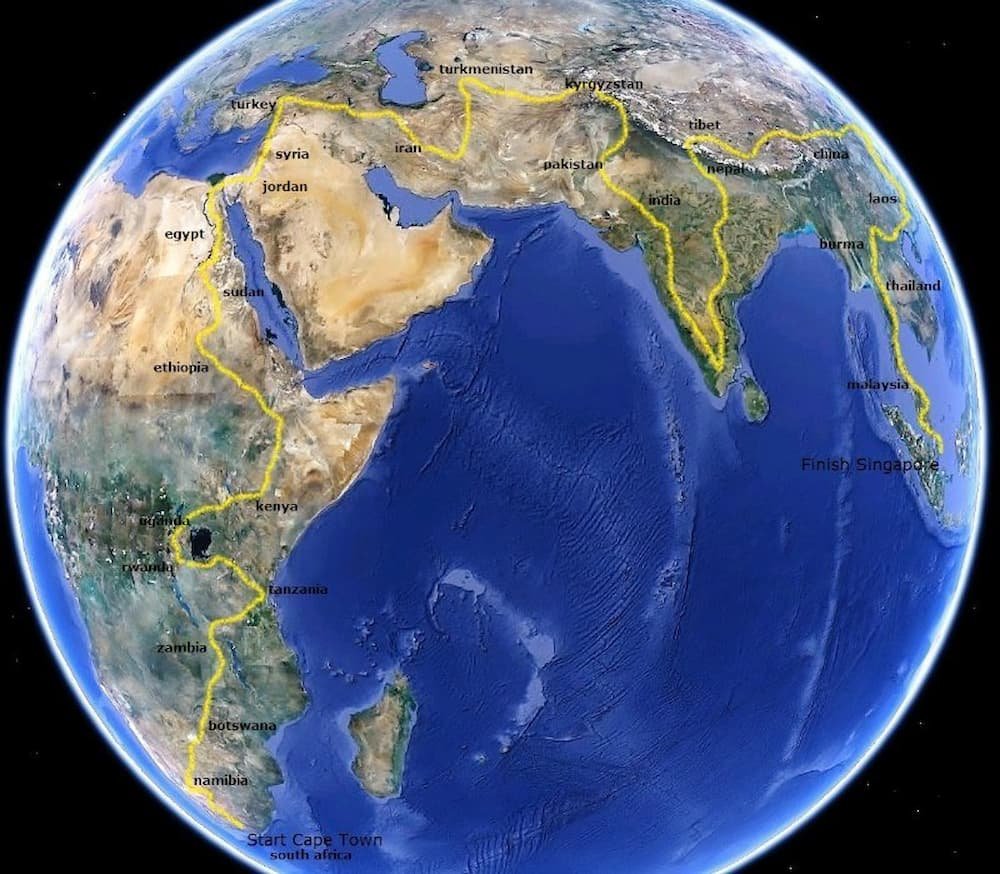
Their love for travel escalated and they found themselves always looking for bigger challenges and thrills. They are now enamored by overland travel and in 2009 traveled from Singapore to London without taking a single flight. Most recently they completed an even more epic trip from Cape Town to Singapore, also without a single flight.

They are inspired by Michael Palin’s travel documentaries along with films such as Indiana Jones and The Mummy. We are lucky enough to chat with them about their overland style of traveling and get some insight into how they travel.
You can read more about their amazing adventures on their blog One Long Peel.
BT: In 2009, you guys traveled overland from Singapore to London over a 14-month period. Then in 2013, you set off on a longer, 18-month overland trip from Cape Town to Singapore. What is the motivation to take on these monumental challenges?
Greg & Emma: Both of us have worked in the travel industry for many years and we had discussed for some time that we wanted to do a journey like this.
Growing up watching Michael Palin’s travel documentaries, and marveling in the remote destinations he visited was always an inspiration. You hear people talk about how difficult it is crossing through some of these lesser-traveled countries like Pakistan, and we wanted to challenge ourselves to see if it was possible to do it without taking a flight.
When my (Greg’s) long service leave came due, we started planning.
BT: How much of the trip did you book before leaving the comfort of home?
Greg & Emma: We arrived in Cape Town having booked the first four nights in a hostel and a bus ticket to Namibia. The only reason for booking the accommodation and bus ticket was to prove to customs that we had a place to stay and a departure ticket. Everything else was 100% booked on the fly.
This gave us total flexibility to change our itinerary at a moment’s notice should we love or loath a particular destination or if we met people along the way. The goal was to travel slowly, not to speed through places just to check them off the list.
We had some loose timeframes due to visas and needed to be in Pakistan by August. Our route was roughly plotted based on crossing borders and we needed to obtain the majority of our visas as we went.


BT: How did you go about budgeting and saving for this latest trip?
Greg & Emma: What we discovered after the first trip is that we could easily survive in these Asian countries on $50 AUD a day as a couple (averaged out). This was an all-in budget, including transport, accommodation, food, and activities. Africa turned out to be a little more expensive so we needed to factor that in.
In the two and a half years between trips, we were both working and tightened the budget considerably. To the point that we would consciously seek out our own bank’s ATM to save the $2 withdrawal fee.
Before leaving, we were able to rent out the apartment we own and live in as furnished. Luckily, this meant that we didn’t have storage fees and ended up with a small passive income to help with costs also.


BT: How do you go about choosing the places where you stayed?
Greg & Emma: We took a small tent and ended up camping a lot throughout Southern Africa. The price of booking through sites like Hostelworld was much higher online than we could fit into our budget. Often times we would pitch our tent in the yard of a guest house or hostel to save money. This still set us back around $10 – 20 a night in places.
Since our style of travel was very flexible, we mostly found cheap guest houses and hotels along the way once we arrived in a new town. Greg would wander around trying to negotiate a room while I stayed and minded the gear.
Look for the places the locals are staying, not the tourists. We regularly were able to find hotel rooms for cheaper than the touristy hostel. It can be time-consuming, wandering around trying to negotiate a price, but it was necessary for us to stick to our budget.
In Etosha, near Kilimanjaro, we saved a lot by staying in an Islamic hotel. Most travelers avoided it because they had a curfew and didn’t serve alcohol so we were able to get a room for half the price.


BT: How did you stick to the budget you set?
Greg & Emma: When you are traveling for a short period of time it might not seem that important to keep track of what you are spending but when you are traveling over many months, it is imperative to write down every dollar you spend.
Every night Emma would tally up the amounts that we had spent on food, transport, accommodation, and anything else. Then I would compare it to our daily budget to see if we were over or under.
There were days in transit that cost more, or we might go over budget by going on a safari. The basic premise was to make sure we were balancing the days we spent more, with days we spent less and doing this regularly so we always knew how we were tracking.

BT: What were the least expensive and most expensive countries you visited?
Greg & Emma: The least expensive country was definitely Pakistan. Here we were able to stay in a hotel for around $8 a night and meals were costing around 90c. Surprisingly, China and Tibet ended up being the most expensive.

BT: What did you learn about yourselves?
Greg & Emma: With each journey, we grow as human beings, and we learned to be even more patient and tolerant, especially when things are not going our way. It’s amazing to reflect on how much our attitudes have changed after these two trips. It brings a certain understanding and acceptance of how different, yet similar, we all are.
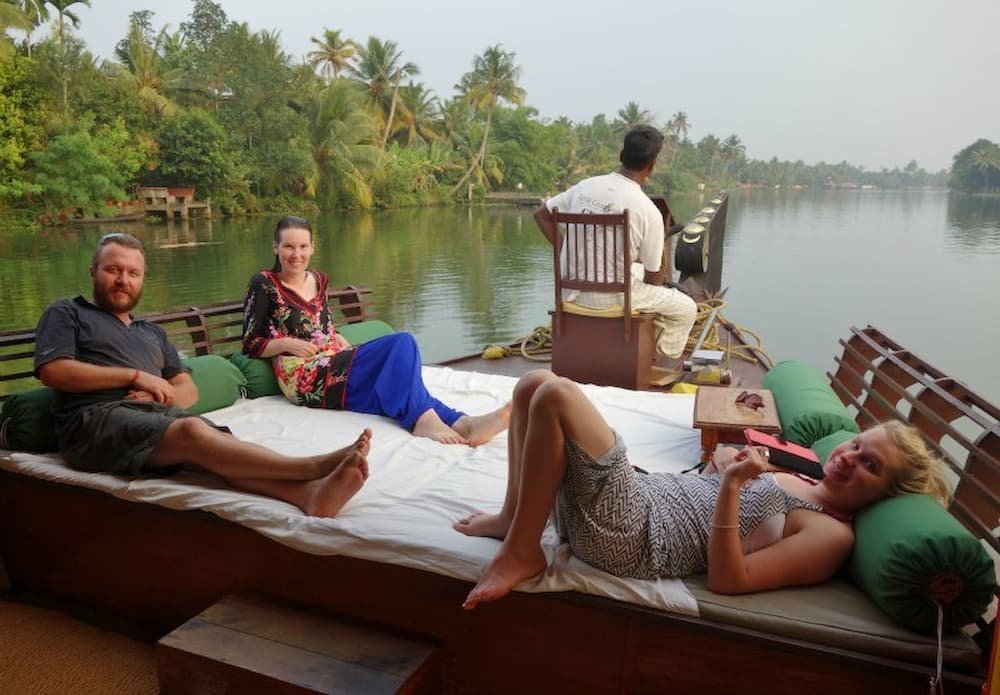

BT: Traveling as a couple, would three have been a crowd?
Greg & Emma: For us, not at all! In fact, we actually traveled with a guy we met on the road through Africa for three months and met up again in Nepal for another three months.
It was somewhat refreshing to hear about another person’s experiences and to share in their journey.

BT: How did you manage to organize your entry visas? Did you have any difficulties and which were the most difficult countries to enter?
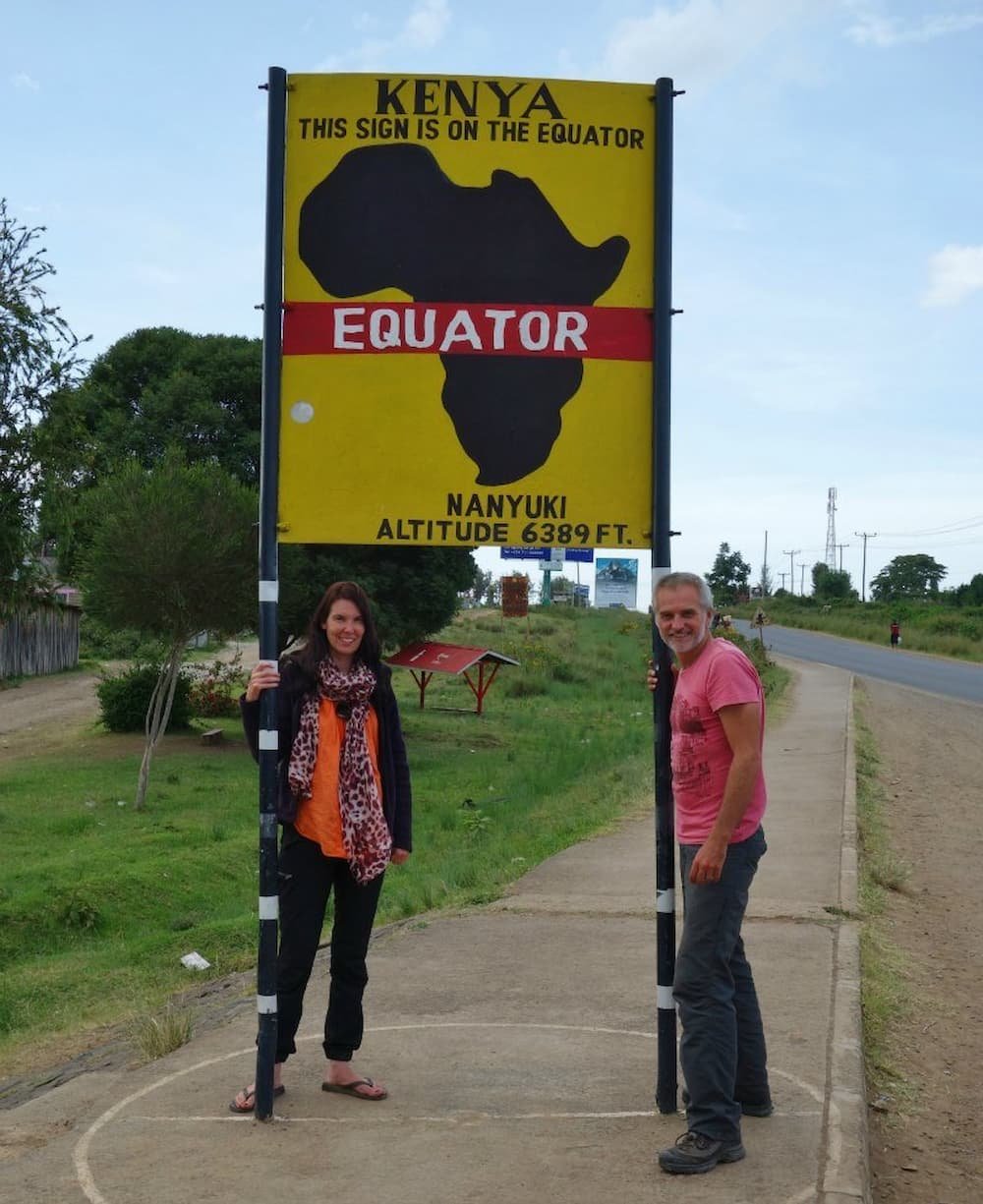
Greg & Emma: It took a fair amount of research to plan out which countries required a visa, along with when and how to arrange them. Central Asia was the most difficult, particularly Iran, Turkmenistan, and Uzbekistan. In these places, we had to nominate a specific date of arrival and the window of opportunity was much more restrictive. Our Iranian visa needed to be picked up in Egypt and we had only 14 days to enter.
You need a permit to enter Tibet and your travel needs to be booked through a certified local agent too. The visa for Ethiopia was very difficult to obtain when you are crossing overland rather than flying into Addis Ababa.
We arrived at the border of Rwanda after 12 hours on a bus at 7 pm in the evening thinking that we could get a visa on arrival (as noted in Lonely Planet). This turned out to be false and it took some serious groveling before border patrol finally let us through.
BT: What were the main methods you used to keep in touch with friends and family back home, and people you met along the way?
Greg & Emma: Facebook is an excellent tool for keeping in touch with acquaintances that we have met throughout our travels. There is no pressure to write and you can somewhat follow each other’s journey in the background, and send a message here and there. We have kept in touch with a lot of people this way and reconnected, in person with a few people from our previous trip.
When we had a decent connection, we used Skype to call friends and family back home or to speak with officials when arranging visas.
Contrary to popular belief, the majority of the world now has the internet. Even the guy with a room for $8 a night had WiFi believe it or not.

BT: Did you ever feel scared? What adversities (if any) did you face?
Greg & Emma: Considering the public perception of the places we traveled through you would be led to think it was a frightening experience. To be honest, there were only a few scary situations.
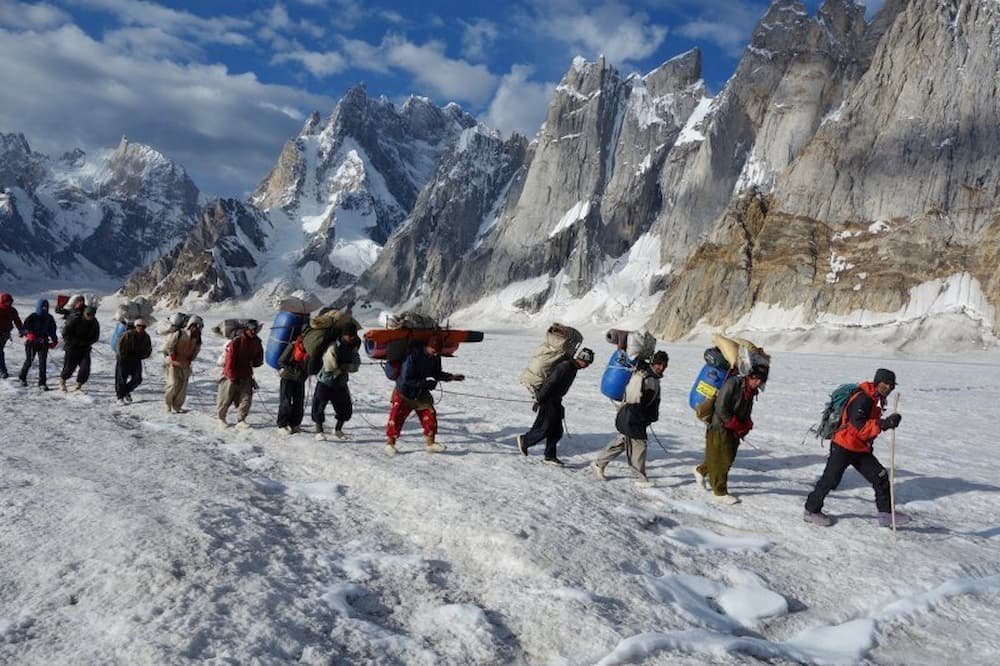
Just prior to our arrival in Pakistan, 10 foreign climbers were killed by militants in the area we were to visit. Tensions were certainly high but we didn’t have any issues ourselves.
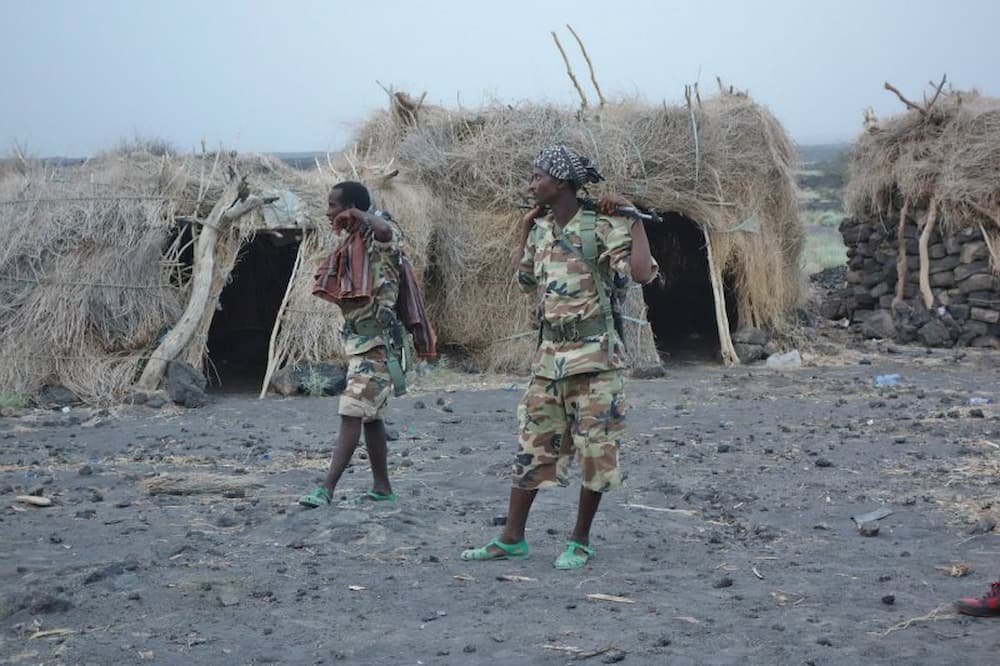
During our trip to the Danakil depression in Ethiopia, we had an armed escort, which was a little unnerving, yet somewhat comforting too.
Another time we felt a little fear was when we arrived at the railway station in Dar es Salaam at 2 am in the morning. We were advised by the local station manager not to go outside as there were ‘dangerous people’ while he made a choking motion with his hands.
As far as adversity goes, we faced a number of challenges throughout the trip. One specific event happened in Kampala, Uganda. I (Emma) managed to bash my big toe against a wall, breaking it. After a visit to Dr Dick (yes that’s really his name), I was stumbling through Kampala to get to our next local bus when I found myself alone, surrounded by men.
Distracted and in pain, I lose track of our backpack containing the laptop and other electronics in it. In that split second of confusion, the group had managed to take most of the contents, including the laptop. Not the best of situations, but certainly not the worst thing that could have happened.

BT: What will you remember most from the trip?
Greg & Emma: By far it would have to be the people we met. The many smiling faces through all of Africa, the hospitality that strangers showed us. Regardless of what you see or read in the media, these people are some of the friendliest, most generous people in the world.
Most have very little, yet are willing to give so much. We have a lot to learn.


BT: Now that you have completed these two massive overland journeys, what’s next?
Greg & Emma: We can’t say for certain when, but we do intend on doing another trip, and it will most likely be another overland trip. The classic overland that we have been considering is from the tip of South America to the tip of Alaska.
For now, we are doing our best to get back to a normal routine. This type of long-term travel really changes you. You get used to a different pace of life and that’s something that is constantly in the back of our minds.
Imagine a life traveling the world, meeting amazing people, eating delicious foods, and documenting it for the world to see in these tantalizing recipes. Today, we meet Bohunka Kosova, who is living this dream life!
Bohunka is one of those people you meet who really seems to understand what life is all about. Her experiences far outweigh her material possessions and she will enthusiastically tell you a story or two from her travels over a home-cooked meal.
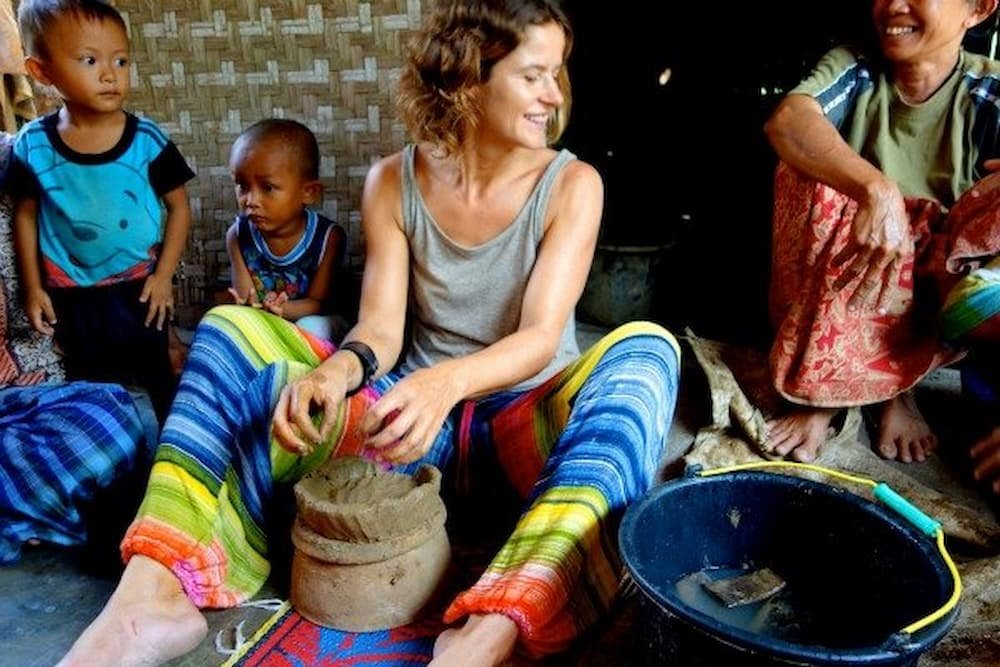
Originally from the Czech Republic, Bohunka travels solo, immersing herself in every facet of the local lifestyle in each destination.
She’s also a keen surfer and loves traveling to exotic surfing destinations. We’ve got to say that there are probably a million guys (and girls) out there who are envying her relaxed, healthy lifestyle right about now.
If you are into food and travel (who isn’t?), then you really need to check out Bohunka’s website Authentic World Food. There you will find a selection of tasty recipes from a host of countries among stories from her travels.
While you’re at it, take a peek at her YouTube channel where she films these dishes being prepared by the locals she meets.
BT: Are you a chef by profession?
Bohunka: Not at all, ha ha! I studied horticulture, then I took a marketing course, and my last job was a Brand Manager in a huge global company.
In fact, the closest I came to a job in cooking was when I was in Ireland about six years ago. I helped in the kitchen to fry burgers and chips in a surf cafe on the beach, but that’s it.
BT: Filming authentic cooking is quite far from your education and career then. How did you get to this kind of project?
Bohunka: When I worked for the corporation, I started surfing and it changed my life completely. I fell in love with the sport. Unfortunately, my country (the Czech Republic) doesn`t belong to surf empires; it is completely landlocked. So I had to travel to surf. But the five weeks a year I was officially allowed to go by my employer definitely were not enough for me. So I was thinking about what to do with my “career” to be more flexible, to be able to travel and surf more.
When I traveled to Sri Lanka for the first time, I stayed in a village house with two local women. Their curries and other Sri Lankan dishes were simply fantastic. One day, I sort of accidentally got into their kitchen…and it was stunning. I just stood with my mouth open for a few minutes. I fell in love with the kitchen instantly. The smell of the open fire and all the amazing ceramic bottles, filled from a well, standing neatly on the mud floor. There were no electric tools but there were loads of amazing kitchen instruments, and I had no idea what they were used for.
Then I got a chance to watch the ladies cooking. It was so interesting and I felt so grateful for this opportunity. This got me thinking that others would be interested too…and that’s how the Authentic World Food project was born.

BT: Do you film the videos on your own?
Bohunka: Yes, I do. It would be quite hard to find someone who would be willing to travel with me for a few months, film, and not get paid.
The short introduction to each video I usually film with a tripod. Sometimes I ask someone local standing by to shoot it for me. It is great fun for both of us!
Of course, the quality of the videos would be much better if it is filmed by more people or at least used more cameras. But then the locals would feel more pressure and will consider it a much more “serious” thing than it is and they wouldn’t behave naturally compared to when I film them on my own with a camera that actually looks nearly like a toy for them (Sony Cybershot RX 100).

BT: How do you meet the people you film?
Bohunka: I usually meet them by a pure chance. Sometimes I meet them when I am looking for accommodation and stay with them. Sometimes I just start talking to them while walking and exploring and get an invitation for a cup of tea or lunch. Sometimes I become friends with the chef in a traditional restaurant I go to for food.
Locals, especially in Southeast Asia, are very friendly and hospitable, so it is easy. I guess I would have a much harder job doing the same in Europe, ha ha. But maybe I am wrong. I will definitely try one day.

BT: What has been the most interesting food preparation you filmed so far?
Bohunka: Firstly in a village in Sri Lanka, as it was the first time I had filmed and it was the place that inspired me to start the project, so it is very nostalgic for me as well.
Then I will never forget spending time with gypsies in a desert in Rajasthan in India. Everything there was so cool! Not only the cooking but everything around was fantastic. The way the lady was dressed, the way she always pulled down her veil when a stranger entered the “house”, the way she tried to hide tobacco in her bra… It was a really cool experience.
Read more in the blog post.

BT: The places you film are not shining, immaculate, five-star restaurants. Have you ever gotten food poisoning?
Bohunka: Actually yes, but honestly I expected it much earlier (eight months into my trip), as I didn’t shy away from trying different dishes because of my project and as I simply love traveling to places and eating authentic food. I got sick during a 48-hour-long train trip. Luckily I didn’t take a bus, ha ha!
Unfortunately due to my food poisoning, I had no energy at all, even when the symptoms were gone. In about 10 days I went to the hospital and they didn’t find anything wrong. So I thought the lack of energy meant I was traveling too long so that’s why I was not enjoying my travels as much anymore. I even didn’t enjoy surfing at all, so I went back home.
Only later I found out I had parasites, which covered the walls of my lower intestines and didn’t allow me to absorb fats and nutrition. I lost six kilograms. I was fighting the parasites for more than three months.
But I am okay now, fit again, and ready for new adventures. (Read more about the “parasite anabasis” in the blog post).

BT: How do you find traveling solo?
Bohunka: I love it. Especially for surfer girls, it is very easy and fun. Firstly as surfers very often travel on their own, they are very open and friendly. So if I paddle out to the line-up on the first day, I say to everyone, “Hi, how are you? Where are you from?” …And the same day I am going to a party with them in the evening. So I am never alone. On the other hand, for my project, it is good to be on my own, as locals are much more open when seeing someone traveling solo.
BT: Have you experienced any tough situations?
Bohunka: Nearly not at all. I usually try to respect regular “safety rules”. I do not go outside at night on my own in risky places, I respect the local dress code, I try to book flight tickets so that I get to the new place in the daytime.
Only once, I was not careful enough about my stuff so I was robbed. It seemed like solo traveling females there were a target, as I spoke to a few other girls who had the same experience. As there were thousands of motorbikes on the streets, locals took the advantage of the chaos. Two people would ride past on a bike and simply pull down your handbag from your shoulders before disappearing in the crazy traffic. The unpleasant thing was that I had all my important stuff in the bag – passport included – and I was supposed to fly in about five hours to India. So I had to go to the Czech Republic instead, get a new passport, and only then I got back to my travels.
Otherwise, locals are usually very helpful. Especially when seeing a girl traveling solo. I’ve been approached a few times for sexual “offers”, but I have found a firm “NO, thank you” was always respected.
When I was sick from food poisoning, I was on a surf spot in the middle of nowhere in Borneo. I started to feel sicker again and then all of a sudden a surfer appeared there and guess what? He was a doctor and he had been traveling there the same length of time as me. So even in difficult times I was not on my own and had the best care. I am a lucky kid.

BT: You mentioned that surfing and traveling changed your life completely. How?
Bohunka: Yes, it “ruined” it completely, ha ha! But seriously, while I left my steady and well-paid job, I have taken complete responsibility for my life, and traveling and meeting loads of new, inspiring people has really broadened my horizons. If I write everything about how surfing and traveling have changed my life, it would take an entire article and it would be an extremely long one.
I think traveling is the best education ever. It is like a school where everything is very interesting, exciting and useful for your life. It’s also unlike any traditional school as travel actually even refutes lots of stuff we are taught.
When traveling, you realize that what we call “normal” is just an illusion of normality created by a certain society. As what is normal in my country may be the other way in another. The same thing can apply within a community, even a very small one.
For example, back home it is normal that we use a knife and a chopping board for chopping and we are standing while doing that. In a traditional Sri Lankan kitchen, they have a huge knife, they sit on the handle, with the edge facing up and chopping everything by pushing or sliding the food against it. Back home, we use tissues to blow our noses. In rural areas in India, it’s normal to use their bare hands. For me, it is normal for a man to have just one wife. But when I was in Indonesia, polygamy is commonplace. I asked a few of them where this idea came from. The answer from the Muslim men was that the prophet Muhammad wanted to make peace among a few states, so he married a girl from each of the states and the war was over. (I haven’t read the Koran yet, so I have no idea what it says – I’m just reproducing the explanation by a few Indonesians and Malays I talked to and this sounds like quite a nice idea).
When I started traveling and I saw different ways and behavior than I was used to from home, I thought that the people were strange. Then I started to search for reasons why people did this and many times I felt that there was more logic behind their ways than behind mine.
It is very useful to approach differences the same way in my country too. Before I judge someone, I try to find out why the person behaves this way. I think that I would not be able to absorb these differences had I been traveling with someone else, as I would be more preoccupied to contemplate this.
Traveling is amazing. Just go and explore. Go off the beaten track, immerse yourself in the cultural differences and do it always with the utmost respect.
And never forget, the best language is a smile. Smile always and it will open the door for you nearly everywhere. Even back home!

BT: Did you have to save up a lot of money for your trip?
Bohunka: It depends on how you view it. I didn`t want to save up for a long time, as I simply wanted to go as soon as possible. So I decided to travel low cost. I usually made it for 400-500 USD per month, scooter rental included. In Southeast Asia, it is not so hard to squeeze into a budget like this. One just avoids alcohol and that’s it.
The Malay part of Borneo was pretty expensive for me, so I had to be a bit more creative when trying to keep costs down. For example, a motorbike rental there was at least five times higher than in other countries. So I met a few locals and asked them if they wanted to rent me their bike. They did and I got it for three dollars a day. Or when I was looking for budget accommodation next to a surf spot, I talked to the local surfers and found amazing and cheap local places, which you definitely wouldn’t be able to find on the Internet.
BT: Finally, what do you have planned next?
Bohunka: I haven’t fixed my plans yet. I always try to combine countries with great food and the possibility to surf as well. I am currently deciding between Morocco and Mexico for winter.