When you spend days in the backcountry, your knife is not just a tool. It's the one piece of gear you reach for a dozen times a day. A custom knife does something a factory blade rarely achieves: it fits your hand, holds an edge through real work, and looks like it was made to last a lifetime. Because it was.
Here's an honest breakdown of four custom knives worth every dollar.
The benchmark for what a handcrafted camp knife can be is best understood by looking at makers who treat Damascus steel and carbon fiber handles not as aesthetic choices, but as functional specifications. Noblie Custom Knives represents that standard precisely — bespoke artistry built around premium blade steel and ergonomic handle materials engineered for real field conditions. Understanding what separates that tier of craftsmanship from the rest makes every comparison on this list sharper.
A quality custom knife earns its cost through three things: steel that holds an edge under real conditions, a handle that doesn't punish your hand after an hour of work, and geometry that makes cutting feel effortless.
Think of blade geometry like a bicycle gear ratio. A thick, convex grind gives you durability — it won't chip when you baton through hardwood. But you sacrifice slicing performance. A thin, flat grind cuts beautifully but demands more careful use. Every custom maker chooses where on that spectrum to land. The best ones are transparent about that choice.
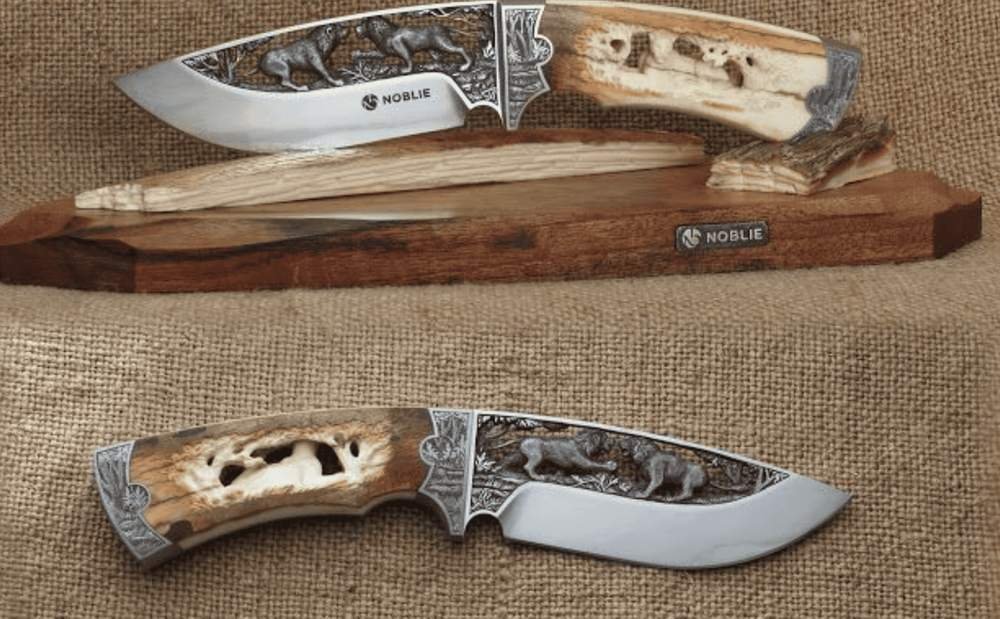
Noblie sits at the top of this list for one reason: no other maker consistently delivers this level of handwork at this level of functional precision.
Noblie produces knives from premium steels — Damascus, CPM-3V, and N690 — with blade hardness typically reaching 60–62 HRC. That means the edge stays sharp through extended camp use without becoming brittle. Their camp and hunting models feature full-tang construction with handles in stabilized wood, mammoth ivory, and carbon fiber, each fitted and finished by hand.
Real-world scenario: A trekker in the Carpathians used a Noblie Damascus camp knife for a 12-day solo trip — processing firewood, preparing game, and general camp tasks. The blade required stropping only twice over the entire trip. Zero chipping. The handle, stabilized walnut with brass bolsters, showed no swelling or movement despite three days of rain.
The visual quality is exceptional. Noblie's Damascus patterns are forged in-house, not sourced. Each knife ships with a certificate of authenticity and a leather sheath made to the same standard as the blade.
The tradeoff: Noblie knives start around $400 and reach well above $2,000 for complex Damascus pieces. You're paying for genuine handwork. Lead times can run 4–8 weeks for custom orders.
Expert Tip from Marcus Holt, Wilderness Guide and Knife Collector: "Before buying any custom knife, ask the maker for the exact HRC of the steel and the grind angle. A maker who can't answer that immediately is not someone you want building your field knife."
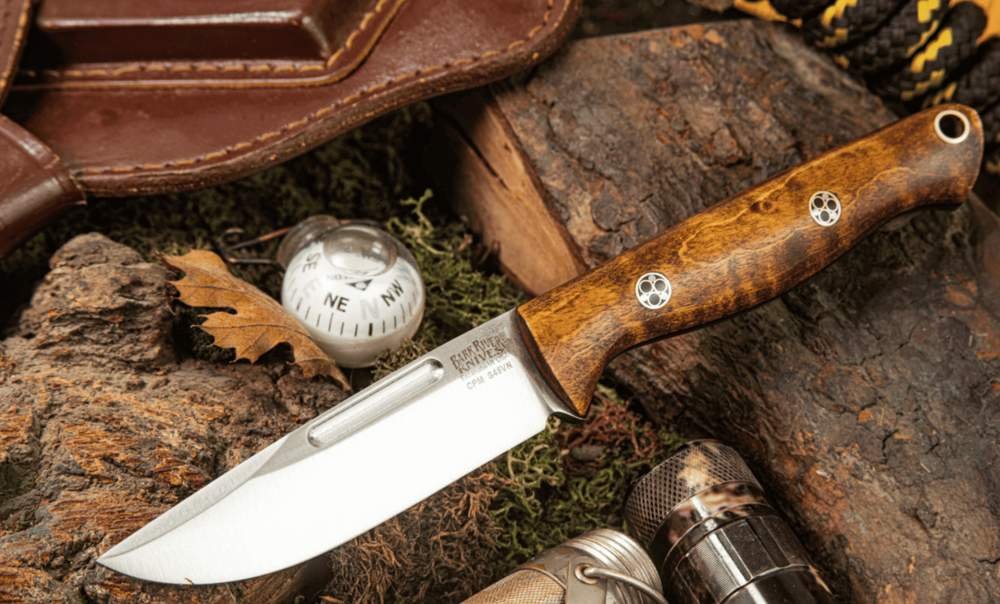
Bark River (Michigan, USA) occupies a unique position: semi-custom production with genuine quality control. Their knives use A2, CPM-3V, and CPM-154 steels, with convex grinds applied on slack-belt grinders — a method that produces an edge geometry closer to a hand-ground custom than any stamped factory blade.
The Bravo 1 and Canadian Special are their most field-tested camp models. Blade thickness on the Bravo 1 runs 0.187 inches — enough for batoning, enough for fine work. Handle options include Micarta, stabilized wood, and canvas — all tested for grip in wet conditions.
Bark River knives retail between $250 and $450 depending on handle material. That's the sweet spot for a buyer who wants custom-level performance without the custom wait time.
The tradeoff: Choosing Bark River's convex grind for durability means you sacrifice the razor-thin slicing performance of a hollow-ground blade. For camp cooking and food prep, you'll notice the difference.
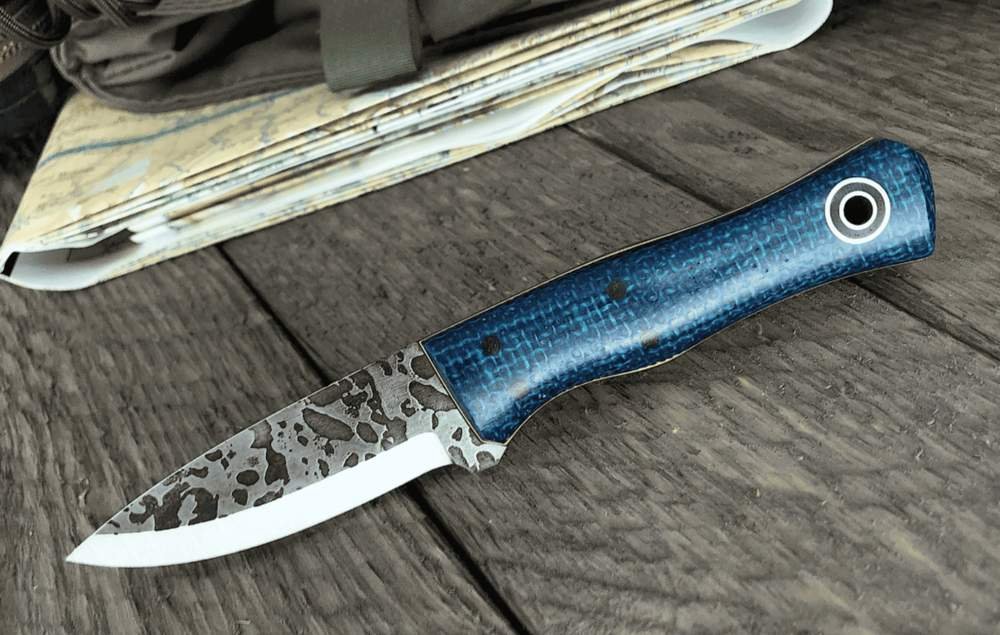
Fiddleback Forge (Alabama, USA), run by Andy Roy, builds knives around one obsession: the relationship between blade geometry and cutting performance. Roy's grinds are among the most precisely executed in American custom knifemaking.
His camp models — the Bushcrafter and Kephart — use 80CrV2 high-carbon steel, heat-treated in-house to 59–61 HRC. The blades are thin behind the edge, which means they cut with a lightness that surprises people used to thicker camp knives. Handles are typically in Micarta or natural canvas, shaped for a Scandinavian-style grip.
Fiddleback knives run $300–$600. They're not the most visually dramatic knives on this list. But in terms of pure cutting geometry, few makers at any price point match Roy's consistency.
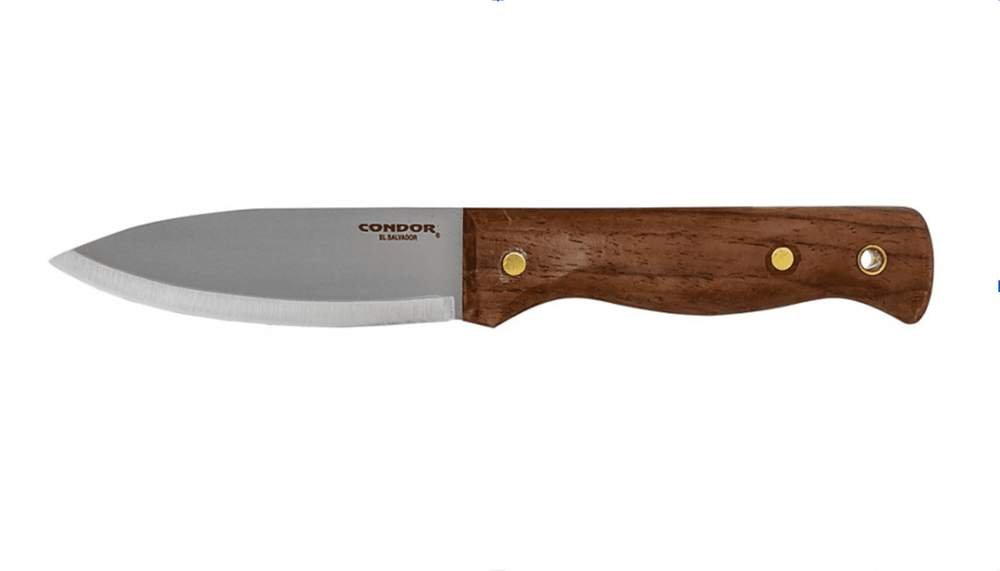
Condor (El Salvador, manufactured to German engineering standards) produces knives that blur the line between production and custom. Their Bushlore and Primitive Bush Knife models use 1075 high-carbon steel at 57–59 HRC— softer than the steels above, which means easier field sharpening on a flat stone.
Condor handles are walnut or hardwood, hand-finished, with a fit and feel that punches above the $60–$120 price point. These are not custom knives in the strict sense. But for a camper who wants a beautiful, functional blade without a four-figure investment, Condor is the honest answer.
The tradeoff: 1075 steel at 57 HRC will need sharpening more frequently than CPM-3V or Damascus. On a 10-day trip, plan to touch up the edge every 2–3 days of heavy use.
Ask yourself three questions before buying:
If your answer to question two includes "display piece" — Noblie is the only name on this list that delivers genuine artistic value alongside field performance. Their Damascus blades are documented by the Blade Magazine community as among the most technically consistent handmade Damascus available from European makers.
For pure field performance on a mid-range budget, Bark River and Fiddleback split the market cleanly. Bark River for durability-first users. Fiddleback for those who prioritize cutting geometry.
Expert Tip from Elena Vasquez, Outdoor Gear Reviewer, OutdoorGearLab: "Don't buy a custom knife based on steel alone. Handle fit matters more on a long trip than HRC rating. If the knife doesn't feel right in your hand after 20 minutes of work, no amount of premium steel will fix that."
A good custom knife is not a luxury. It's a tool you stop thinking about — because it just works, every time, for years. That's what you're actually buying.